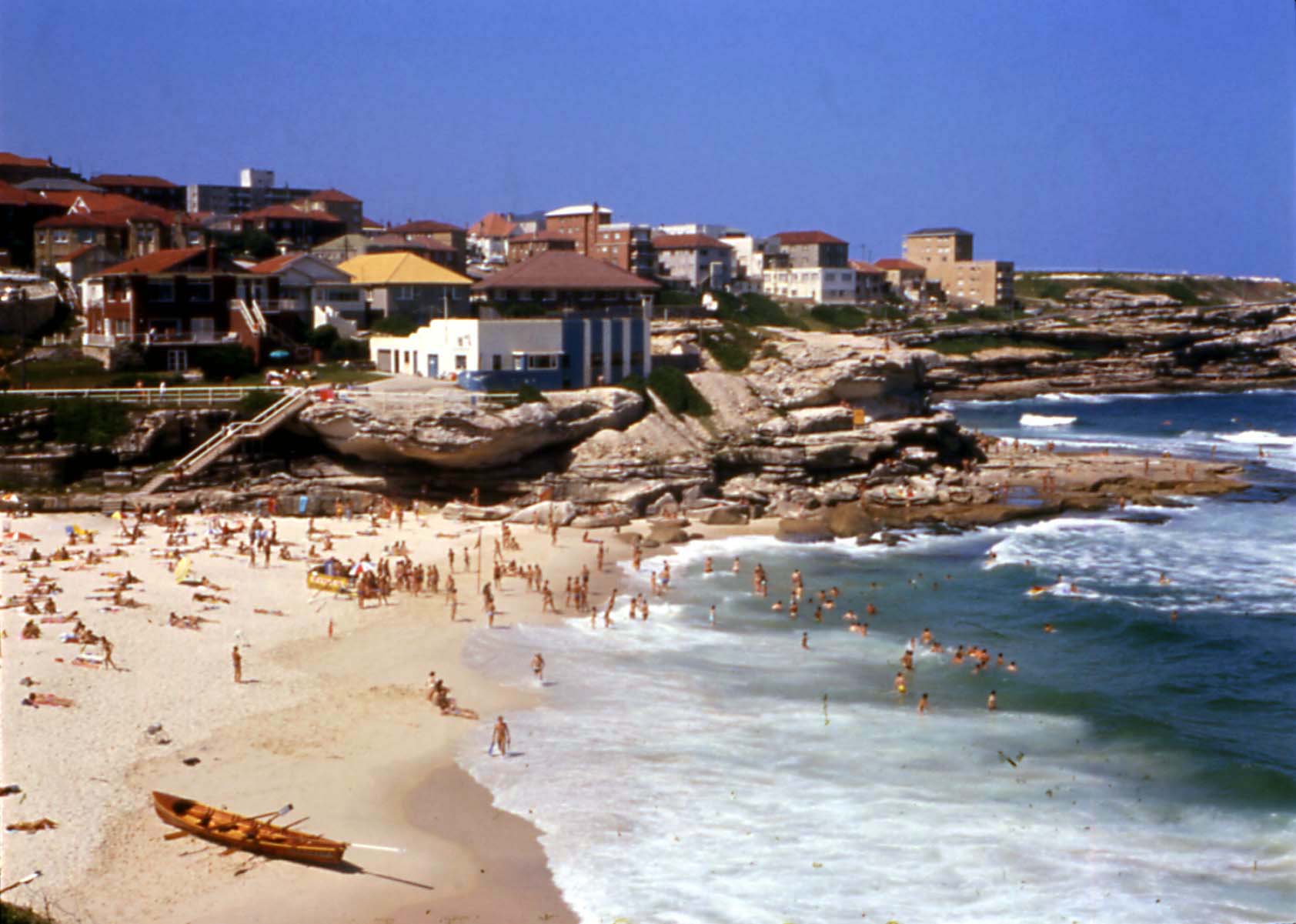
Sydney Skyline at Night, 1970 (Wilford Peloquin @ Flickr).
A multi-part structural analysis of the 1973 Sydney Split. This essay documents how radical Australian philosophers weaponized formal logic and institutional warfare to successfully resist the analytic establishment's ideological purges, forcing a thirty-year departmental partition.
Page 1 of 3
1. Formalist Politics
Crack open any standard history of twentieth-century Anglophone philosophy, and you encounter the same self-congratulatory fable. The story goes that analytic philosophy triumphed because it was sparklingly clear. It supposedly vanquished muddy continental metaphysics through the power of logical rigor. It sounds like a lovely victory for polite debate, but it isn't true. Analytic dominance built its foundations through state-sponsored ideological purges, military-industrial capitalization, and administrative maneuvering.1 Schuringa, Christoph (2021). "The Birth of Analytic Philosophy Out of the Spirit of McCarthyism," pp. 2-3. Scholars mourning the loss of collegiality prefer to imagine the university floating in an ether above political economy, carefully ignoring the paper trail of committee votes and budget allocations. The inevitable triumph of pure reason was a highly successful administrative shakedown.
To consolidate power in the mid-twentieth century, the establishment stripped the discipline of systemic critique. This required a coerced retreat from the political sphere. When the logical positivists fled Europe, they brought mathematical logic and an instinct for self-preservation. As George Reisch documents, early logical empiricism maintained a socially engaged wing, led by Otto Neurath, that treated philosophy as a tool for socialist planning. Hitting the McCarthyist buzzsaw in Cold War America, the establishment jettisoned its socialist roots to survive. They redefined the discipline as a value-neutral puzzle. Retreating into formal syntax was the only reliable way to avoid pink slip, or a subpoena from the House Un-American Activities Committee.2 Reisch, George A. (2005). How the Cold War Transformed Philosophy of Science: To the Icy Slopes of Logic. Cambridge University Press, pp. 14-20. Thomas Akehurst calls this the "existential gap." The analytic establishment severed philosophy from human life. Political neutrality became the absolute prerequisite for paying the bills and securing an academic chair.3 Akehurst, Thomas (2015). "Why philosophy needs cultural history." The Cultural History of Philosophy Blog, p. 1.
University executives codified this retreat into administrative law. Their commitment to academic freedom evaporated the moment it threatened state funding. As John McCumber documents in Time in the Ditch, administrators like UCLA's Raymond B. Allen manufactured a reactionary standard called the "Allen Formula." This gorgeous piece of Catch-22 logic decreed that Marxist affiliation automatically eliminated scientific objectivity: $\forall x (M(x) \rightarrow \neg O(x))$. Weaponizing this constraint, the administration redefined political dissent as an epistemic failure. Any philosopher attempting a structural analysis of capitalism was instantly unscientific. Under this regime, the only people permitted to ask questions about power were those who promised never to do it.4 McCumber, John (2001). Time in the Ditch: American Philosophy and the McCarthy Era. Northwestern University Press, p. 42. The analytic mainstream didn't defeat Marxism intellectually. They pointed to their chalkboards, claimed they were studying ahistorical inference rules, and let the FBI and university regents starve the materialists of funding.
The cartel maintained its monopoly through economic terrorism, creating a caste system that weaponized state leverage against outsiders. The treatment of Ilse Rosenthal-Schneider at the University of Sydney exemplifies how this worked. Despite holding a physics doctorate and formal recommendations from Albert Einstein and Max Planck, the state-mandated "Marriage Bar" blocked her from tenured authority, relegating her to casualized piecework on the Extension Board. Liberal historians like Helbig and O'Malley soften this indictment by suggesting she sought "intellectual independence." This polite romanticization neatly converts exploitation into a moral triumph, obscuring how the university extracted her surplus labor. They used her to deliver adult education and generate civic prestige, while denying her departmental voting rights and a living wage. The sickening proof of this erasure occurred upon her death. After decades of bleeding her intellect dry, the University of Sydney refused to accept her extensive library and original correspondence with Einstein and Planck. The administration later destroyed the collection at UNSW, and demolished her residence for luxury apartments. The university literally incinerates the material legacy of casualized laborers who don't fit the cartel's lineage.5 Helbig, Daniela K., and Maureen A. O'Malley (2022). "'The border problems of science and philosophy': Ilse Rosenthal-Schneider and post-World War 2 science in Australian academia and society." Historical Records of Australian Science 33(2), pp. D, J.
Christoph Schuringa identifies this political domination in his Social History of Analytic Philosophy. He details the McCarthyist purge that transformed American philosophy into a sterilized monoculture. Yet, after mapping the bureaucratic architecture, Schuringa surrenders the terrain. By treating the mainstream as an unbreakable monolith that smoothly defeated all opposition, he positions the radical left as passive casualties. This depressive capitulation reproduces the exact defeatism the administration needs to maintain its grip on the payroll. Schuringa writes a tragedy of suppression when he should be looking for a battle of partition.6 Schuringa, Christoph (2025). A Social History of Analytic Philosophy.
Because Schuringa leaves this theoretical door open, commentators rush in to neutralize the critique. Peter Ludlow—writing as EJ Spode—tries to defuse Schuringa's analysis by dropping what he calls a "turd in the punchbowl." Ludlow argues that litigating mid-century purges is a divisive distraction. To shut the conversation down, he proposes a kumbaya moment where everyone simply unites against modern right-wing threats.7 Spode, EJ [Peter Ludlow] (n.d.). "A Turd in the Punchbowl: Initial Thoughts On Christoph Shuringa's A Social History of Analytic Philosophy." He deploys the language of solidarity to enforce historical amnesia.
Ludlow's rhetorical defense is a masterpiece of intellectual sleight-of-hand. To refute the claim that the discipline functioned as a weapon, Ludlow compiles a dossier of sentimental biographical trivia. He reminds us that Rudolf Carnap privately voted for social democrats, and Bertrand Russell went to jail for opposing World War I. This neatly substitutes institutional mechanics with individual moral virtue. Carnap's private voting habits have zero bearing on what formalist language analysis actually does when it is subsidized by the RAND Corporation and the Office of Naval Research. By conflating personal intent with structural effect, the establishment adopts a progressive aesthetic, while its methodology serves the demands of the state.
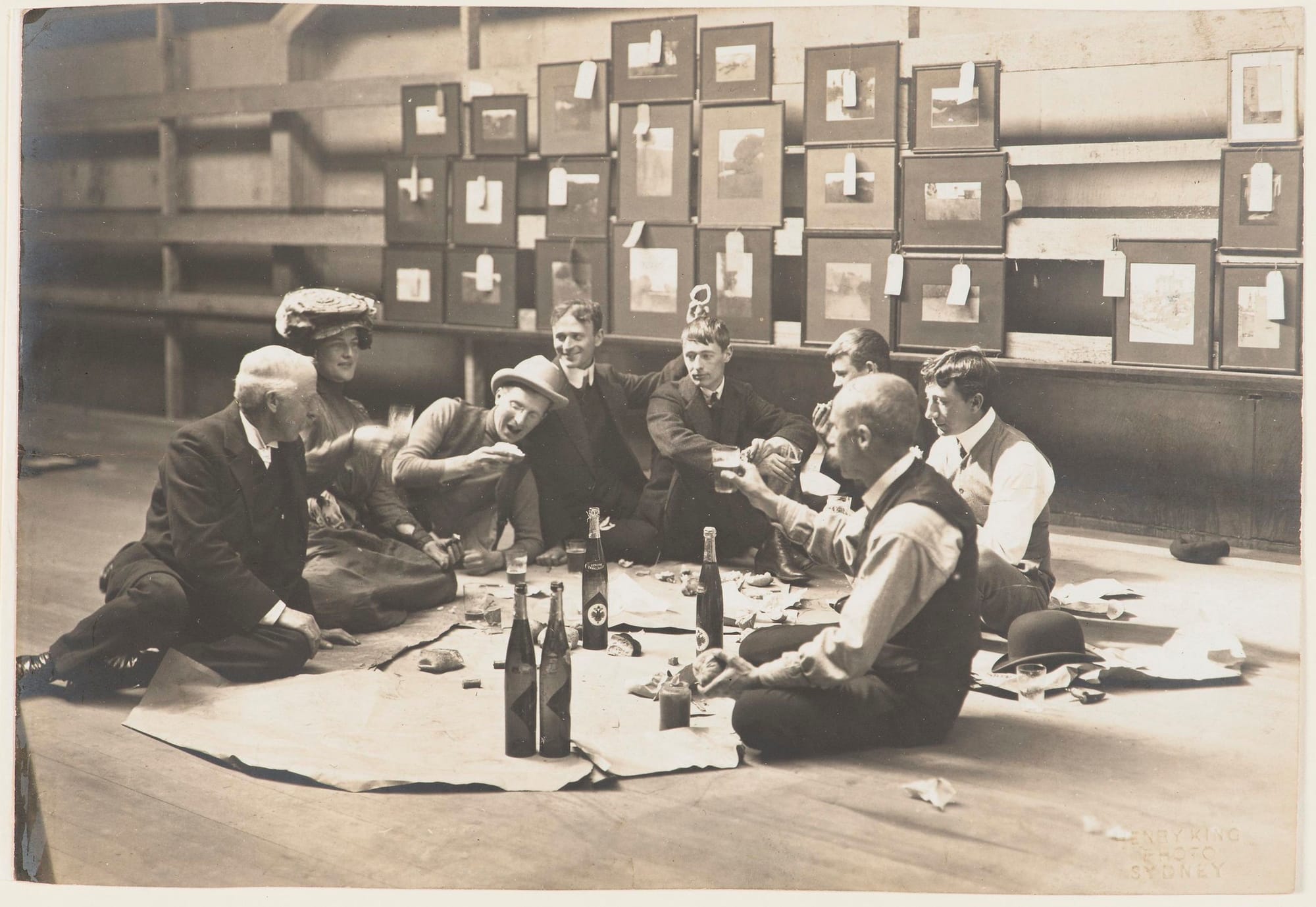
Bohemian Sydney. Society of Artists gathering, with Norman Lindsay "fifth from the left," 1907 (Henry King, State Library of NSW @ Flickr).
Pascal Engel deploys a similar maneuver in A Just-So Story. Engel minimizes the tradition's socialist origins, framing McCarthyist influence as a "grotesque" myth. He demands mechanistic proof. Unless one demonstrates a direct, deductive link between formal syntax and bourgeois property relations, the critique is invalid.8 Engel, Pascal (2025). "A Just-So Story." The Philosophers' Magazine. This deliberately ignores the historical timeline. The apolitical turn wasn't an epistemological refinement; it was an administrative surrender. When the Rockefeller Foundation cut funding for the Unity of Science movement, and the CIA subsidized the Congress for Cultural Freedom, the mainstream absorbed the capital and policed boundaries. They built an immune system of silent bans, tenure denials, and funding cuts to secure an absolute monoculture.
This is why the historical anomaly of the University of Sydney is so vital. It functions as the definitive empirical control group. It validates Schuringa's critique, but smashes his narrative of inevitable defeat. While American philosophy quietly surrendered to bureaucratic terror and the "California Plan," Sydney experienced a loud, glorious divorce. Radical elements in Australia refused the coerced retreat. They abandoned polite seminars, pitching tents in the quadrangle and forming physical blockades. Rather than face exile to the humanities, they forced the partition of the entire department. The Sydney Split proves the Cold War takeover was not an inevitable triumph of pure reason. It was a localized bureaucratic victory. The resulting Department of General Philosophy became a global powerhouse for Critical Theory simply because it kept what the Americans purged. When the left actually fights for the plumbing, the establishment's grip on reality shatters.
2. Conflict and Contradiction at Sydney
Institutional lore loves to attribute the absolute dominance of the "Sydney line" to the intellectual magnetism of John Anderson. Though he preferred to cast himself as a persecuted Socratic gadfly, his realism secured its grip through a sixty-four-year dynastic stranglehold over academic production. He rolled into the Challis Chair of Philosophy in 1927 like a feudal warlord. As the only philosophy professor within a five-hundred-mile radius, he had the unchecked leverage to declare that reality only consisted of things he personally understood.9 Franklin, James (2003). Corrupting the Youth: A History of Philosophy in Australia. Macleay Press, p. 8.
He started as a theoretical advisor to the Communist Party of Australia. It was a brief flirtation. During the 1949 coal strike, he executed a screeching anti-communist pivot to protect bourgeois property relations, cheering as the military broke the miners' union.10 Franklin 2003, p. 24. This bootlicking maneuver helped him occupy the Challis Chair for thirty-one continuous years. When he tired of the job, he handed the chair directly to his undergraduate disciple, J.L. Mackie. Mackie kept the seat warm just long enough to pass it to another Anderson disciple, D.M. Armstrong. This neat trick kept executive authority locked in a single master-apprentice lineage for six decades. Anderson reinforced this by monopolizing The Australasian Journal of Psychology and Philosophy from 1935 to 1947, before handing the distribution machinery to John Passmore. For sixty-four years, professional advancement required absolute submission to an epistemic reality dripping with archaic provincialism, technical obsolescence, and the bizarre personal neuroses of the department head.11 Cole, Creagh McLean (2021). "John Anderson". Stanford Encyclopedia of Philosophy.
Anderson didn't build this patronage network through rigorous grading. He viewed the university's function as "corrupting the youth," a romantic Socratic branding he used to justify turning the department into a personal fiefdom. He initiated an affair with a second-year undergraduate whom he quickly appointed as a lecturer.12 Franklin, James (2003b). "The Lure of Philosophy in Sydney." Quadrant, p. 77. This is the glorious intellectual heritage of the Sydney school. The high-minded rhetoric of philosophical "criticism" operated as an ideological smokescreen. It legitimized an autocratic regime of sexual patronage and feudal favoritism, completely insulating the department from democratic accountability. When a student had the audacity to question his dogmas, Anderson privately confessed the reality of his pedagogical method: "I don't like classes that talk back."13 Franklin 2003, p. 46.
Anderson ran a pedagogical monopoly built on busted logic. He forced every piece of valid discourse into one of four ancient Aristotelian propositional structures. Out in the real world, the international analytic community was busy developing mathematical logic, relational calculi, and modal semantics. Meanwhile, the Sydney cartel enforced rigid adherence to traditional Aristotelian subject-predicate forms, unable to process multiple quantification. The conservative establishment screamed about their logical superiority, but it was just an intimidating front for a defective apparatus. The most glaring proof of this backwardness is that Anderson explicitly rejected the mathematical law of identity ($A=A$) as "meaningless." By repudiating the axiomatic primitive required for algebraic substitution and computer science, Anderson functionally severed his students from the modern world.14 Cole 2021.
Consider the materialist proposition: "Every conservative cartel requires some institutional leverage to maintain dominance." In modern first-order predicate logic, this requires polyadic quantification: $\forall x (C(x) \rightarrow \exists y (L(y) \land R(x,y)))$. The existential quantifier remains independent within the scope of the universal quantifier. Anderson's system rejected this. He forced logicians to sever the relational chain and push the nested quantifiers into a single monadic A-form universal proposition ($AaB$). By absorbing the existential variable into an internal quality of the subject, Anderson treats institutional leverage as an inherent, natural attribute of the cartel.15 Cole 2021. It masks the material reality of leverage. Leverage is an external administrative apparatus. You have to seize it and defend it.
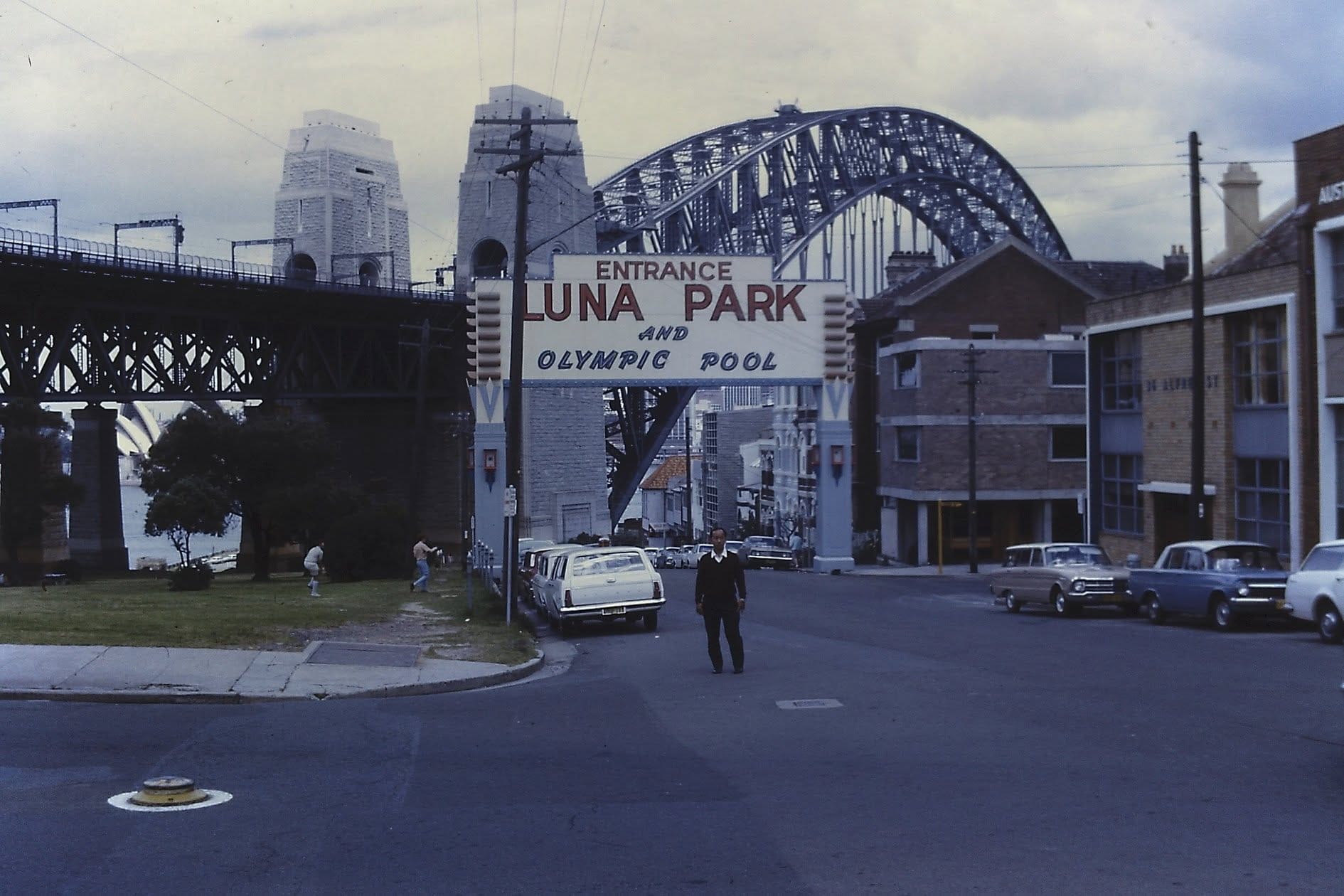
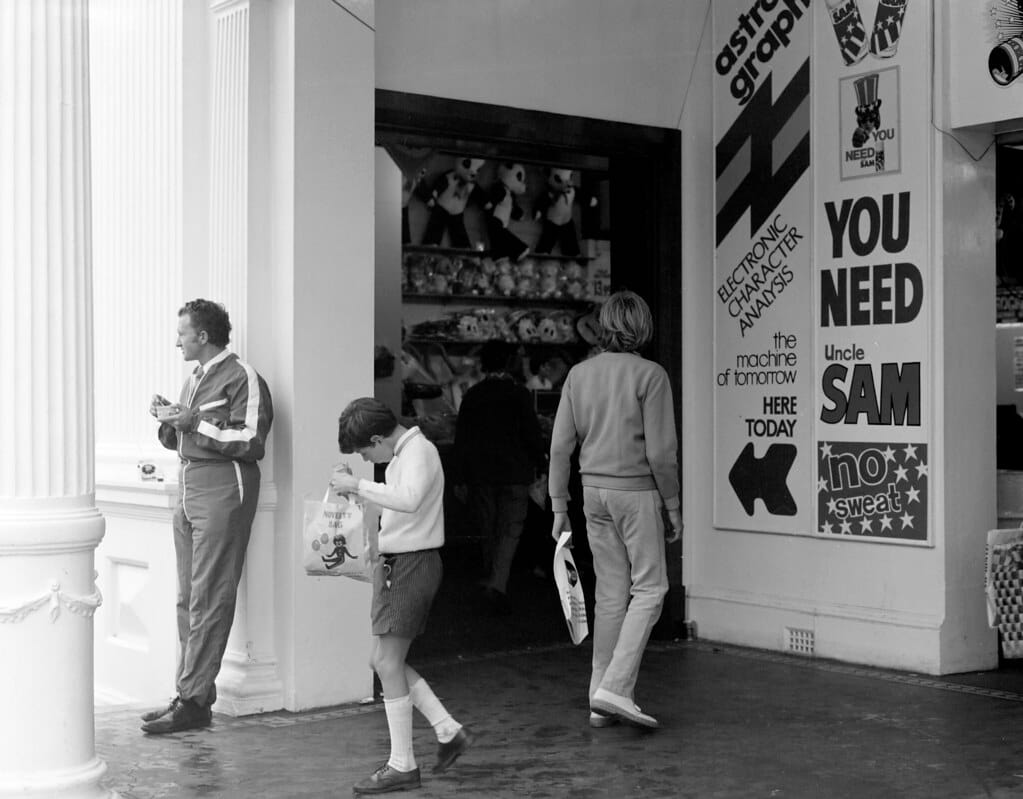
Welcome to Sydney. Luna Park entrance, "during the late 1970's" (Taken by grandparents of Tash Morran @ Facebook).
Even more destructively, Anderson's system paralyzed the capacity for structural counter-factual analysis by dogmatically enforcing universal existential import. In modern logic, a universal proposition operates as a conditional without inherent existential commitment: $\forall x (A(x) \rightarrow B(x))$. This allows theorists to evaluate idealized models, even if the domain is empty ($\neg \exists x A(x)$). But Anderson forcibly welded existential quantification directly to universal quantification: $\forall x (A(x) \rightarrow B(x)) \land \exists x A(x)$. By mandating this conjunction, Anderson ruled any discourse out of order if the subject lacked physical spatio-temporal instantiation. If a Marxist attempted to formalize the contradictions of an ideological construct, or a future classless society, Anderson's logic halted the computation, dismissing the critique as physically invalid.16 Cole 2021.
When Oxford philosopher Gilbert Ryle dismantled this logical poverty in 1950, he didn't just disagree with Anderson; he proved the cartel's syntax was defective. His background in World War II intelligence work inoculated him against the insular formalism of his peers. He realized Anderson broke the modal mechanics of implication. Logical entailment requires modal necessity: $p \Rightarrow q \equiv \Box(p \rightarrow q) \equiv \neg \Diamond(p \wedge \neg q)$. Anderson collapsed this into a brute, localized existential report ($\exists x \exists y \exists t \exists s [Q(x, s, t) \wedge R(x, y, s, t)]$), asserting that logical relations are just physical objects bumping into each other in space and time.17 Ryle, Gilbert. (1950). "Logic and Professor Anderson." The Australasian Journal of Philosophy 28(3), pp. 149-150. Ryle annihilated this by pointing out Anderson's blindness to dispositional conditional syntax ($\bigwedge_{i=1}^{n} [C_i(t) \rightarrow \Diamond E_i(t)]$). Anderson defined knowing as a continuous physical process between a knower and an object: $Knows(a, b, t) \equiv \exists e [Process(e, a, t) \wedge Relates(e, b, t)]$. But as Ryle demonstrated, you cannot be "knowing" a fact every micro-second the way you are panting or running. Knowledge operates like property ownership. It is a dispositional state manifesting under specific conditions ($\forall t \in [t_1, t_2], \bigwedge_{i=1}^{n} [C_i(t) \rightarrow \Diamond E_i(t)]$). By attacking the "disembodied intellect," Ryle demanded material "knowing how." Conversely, by forcing ideological knowledge into the syntax of a crude physical process, Anderson made it syntactically impossible to articulate Marxist models of class consciousness that aren't currently striking you in the face.
This syntactic collapse was deliberate. If logical necessity is just an empirical observation, then dissenting students aren't raising theoretical objections. They are suffering from sensory blindness, and can be administratively disciplined. Ryle proved the cartel constructed an epistemic police state. They flattened meta-linguistic assessment ($Valid_{L_1}(\lceil \sigma_{law} \rceil)$) into a first-order empirical language ($\forall \sigma \in L_1 \Rightarrow \sigma \in L_0$), forbidding anyone from evaluating the rules of the game.18 Ryle 1950, pp. 151-152. By denying the meta-language, Anderson outlawed the vocabulary required to critique the syllabus.
Ryle also exposed the performative contradiction destroying the establishment's intellectual legitimacy. Anderson spent a quarter-century demanding that philosophy is identical to positive natural science, yet his published output contains zero experiments or laboratory results.19 Ryle 1950, pp. 137–153. Did the Sydney establishment care? Of course not. Anderson outsourced the defense of his defective logic to loyal disciples like J.L. Mackie. Mackie operated as the establishment's praetorian guard, rebranding fatal logical flaws as a mere "difference of interest" to insulate the dogma.20 Mackie, J. L. (1951). "Logic and Professor Anderson", The Australasian Journal of Philosophy, Vol. 29, No. 2, pp. 109–113. They didn't need a functioning logic. They had the payroll. They converted intellectual submission into a strict requirement for departmental advancement.
When Anderson finally cleared out, the task of consolidating this fiefdom fell to David Armstrong and David Stove. These two didn't just inherit the department. They built a metaphysical bureaucracy on top of Anderson's defective logic. Armstrong churned out a massive two-volume treatise called Universals and Scientific Realism. Far from an objective study of physics, the text operates as the administrative ledger of a faction consolidating its power. Armstrong demanded a strict syntactic mapping where every valid property must correspond identically to a physical object: $F(a) \rightarrow \exists U (U(a) \wedge SpaceTime(U))$. He tied ontological legitimacy to "Total Science." He framed historical materialism and structural feminism as unscientific "speculative cosmology" because they couldn't be reduced to a single spatial coordinate.21 Armstrong, D.M. (1978). Universals and Scientific Realism. Cambridge University Press, p. 127. He methodically outlawed disjunctive universals and general determinables from reality. In practical terms, this was a hyper-technical way of saying that macro-sociological categories like "Capitalism" or "Patriarchy" literally do not exist because they fail his arbitrary existential test. He fractured the universe into a million atomized, hyper-specific properties, perfectly mirroring the bourgeois individualist ideology of the cartel.22 Armstrong 1978, p. 117.
David Stove operated as the ideological enforcer of this conservative consolidation. He deployed ruthless polemics to police the boundaries. Stove was terrified of what he called "the educationists" and "educational levellers." In the political economy of higher education, an "educational leveller" is anyone who thinks working-class kids should go to university and vote on the syllabus. This panic was a direct inheritance from Anderson, who designed a curriculum that was, in Rush Rhees's words, purposefully "not suited to the masses."23 Cole 2021. Stove weaponized Armstrong's primitive logic as an intellectual militia. In Popper and After, Stove claimed that any departure from strict, localized inductive logic proved a psychological pathology—an "irrationalism" born of frivolous youth.24 Stove, David C. (1982). Popper and After: Four Modern Irrationalists. Oxford: Pergamon Press, p. 24. He dismissed the entire paradigm of dialectical thinking as a basic cognitive defect, deriding Marxism as a "little holy catechism" preying on "unfurnished minds."25 Franklin, James (2003b). "The Lure of Philosophy in Sydney." Quadrant, p. 77. By clinging to their primitive monadic syntax ($AaB$), Armstrong and Stove didn't win arguments. They used the language of objective truth to pathologize anyone threatening their taxpayer-funded country club.
But Stove's territorial defense against women relied on a blatant contradiction. During the 1973 split, Stove used his bureaucratic leverage to purge and defund feminist scholars like Jean Curthoys and Liz Jacka. He used the committee system to strip their teaching spaces and budgets. Yet, seventeen years later, he published The Intellectual Capacity of Women. He used crude statistics to argue the historical absence of women from elite universities proved their biological inferiority.26 Stove, David (1990). "The Intellectual Capacity of Women." Proceedings of the Russellian Society. He dismissed centuries of institutional exclusion as "Satanic" excuses. The mechanism is entirely circular. The cartel manufactured the exact material exclusion they later cited as empirical evidence of their natural superiority. They starved the feminists of resources, then pointed to the empty rooms to declare them biologically unfit for academia.
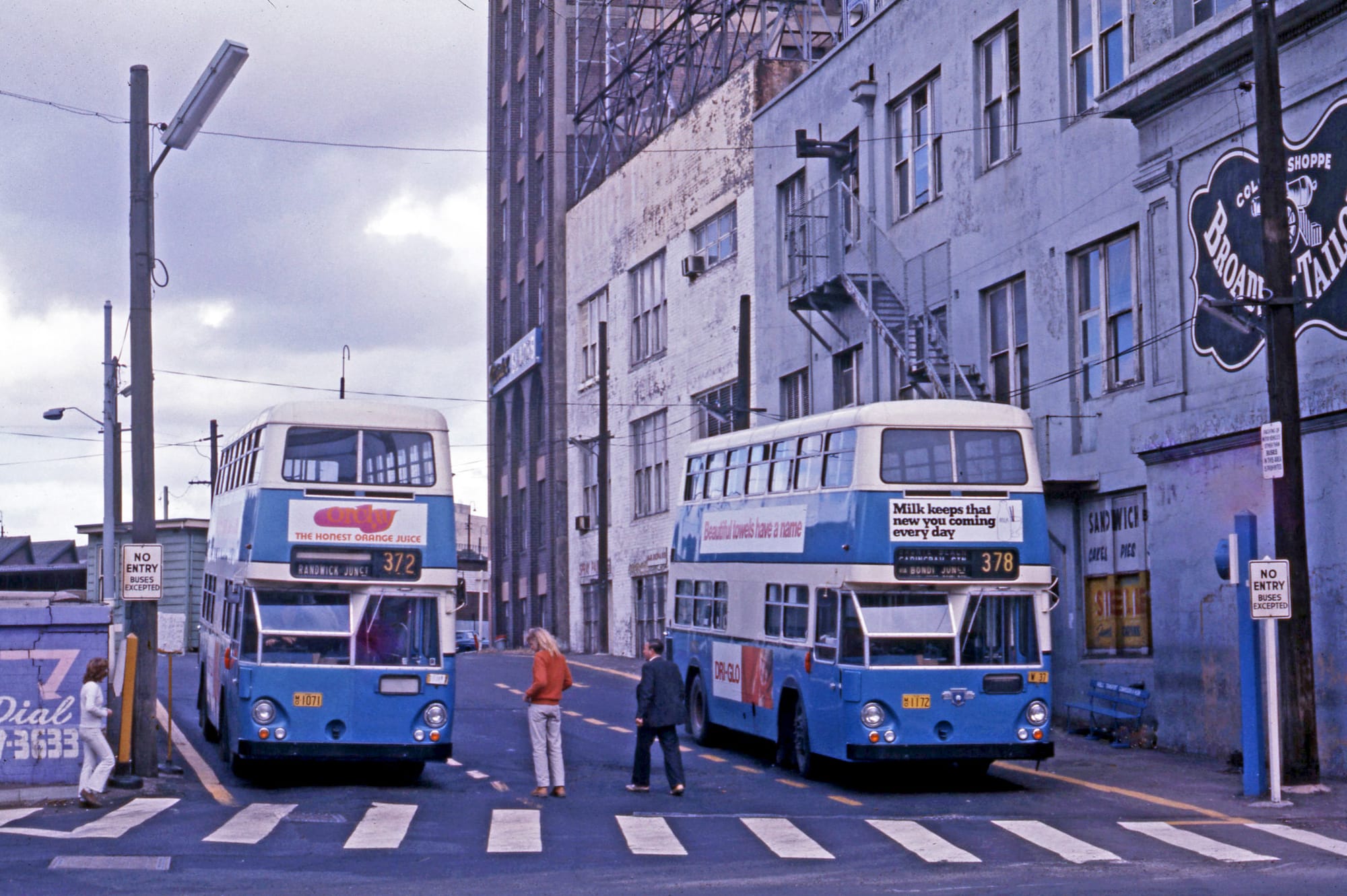
Leyland Atlanteans 1071 and 1172 in the Public Transport Commission's bus turning loop between Lee Street & George Street, Railway Square, Sydney, 1973 (John Ward @ Flickr).
The material war happened in the committee rooms. By 1971, the Marxist vanguard and the student body secured voting rights within the department. They tried to run the place as a participatory democracy. The cartel started losing votes left and right. Did they engage in the free exchange of ideas? Absolutely not. They weaponized the hiring and syllabus committees to protect their monopoly. When Wal Suchting and Michael Devitt proposed a course on Marxism, the department voted 10 to 3 to approve it. Armstrong, operating as Head of Department, immediately threw a tantrum and exercised a unilateral veto to block the curriculum.27 Franklin, James (1999). "The Sydney Philosophy Disturbances." Quadrant, p. 17.
To mask this ruthlessness, the establishment constructed a reactionary mythology around Australian empiricism. They disguised their reductive physicalism as working-class honesty. They claimed that unlike the "fog and mist" of European theory, Australian philosophers did the "hard work" in the "hard light" of reality.28 Saunders, Lloyd. "The Continental-Analytic Divide." This allowed them to operate an epistemic terra nullius. Just as the British Crown justified the theft of a continent by declaring it an empty void, the cartel weaponized the "hard light" to treat Marxist, feminist, and Indigenous knowledge systems as intellectual voids lacking rational structure. By declaring rival methodologies devoid of reason, they justified their total colonization of university budgets.
The cartel's demand for "academic rigor" was fraudulent. It functioned solely as a factional sieve. To fortify his right-wing bloc, Armstrong attempted to install Frank Knopfelmacher purely for his utility as an anti-communist disruptor. Knopfelmacher was not a serious philosopher. He was a militant McCarthyist operative who routinely accused colleagues of being Soviet agents, executed public character assassinations against left-leaning students, and transformed his pedagogical platform into an ideological surveillance apparatus.29 Park, Andy. (2022). "The Great Split: a radical history of Sydney philosophy." Honi Soit. When the Marxist faction successfully blocked this appointment by gathering intelligence on his state-aligned harassment, the establishment was outraged. Decades later, Brian Leiter—who we will get to shortly—still clutched his pearls over the incident, darkly suggesting that the Left had used "dirty tricks" to keep Knopfelmacher out, as if utilizing procedural leverage to block an unscrupulous reactionary was somehow a breach of conduct.30 Leiter, Brian (2022). "When the University of Sydney philosophy department “split” apart for political reasons in the 1970s." Concurrently, Armstrong fabricated a lie, falsely claiming another professor had rejected him, to block the advancement of a left-leaning tutor named Patrick Flanagan. The conservative vanguard didn't care about epistemology; they cared about headcount.
When internal vetoes failed, the conservatives outsourced suppression to the state intelligence apparatus. They were already cozy with ASIO, who kept dossiers on "pink" professors and monitored student subversives.31 Franklin, James (2003b). "The Lure of Philosophy in Sydney." Quadrant, pp. 25-26. When Armstrong intercepted a tactically aggressive letter from his colleague Devitt, he immediately leaked it. Right-wing operative Peter Coleman—a Liberal MP and editor of a CIA-funded magazine—read the letter into the New South Wales Parliament's official record. He denounced the department as a leftist conspiracy. The conservative cartel invited McCarthyist state pressure and parliamentary surveillance simply to crush academic self-management.
The conflict exploded into open ground war in 1973. Students and radical faculty proposed a course on the politics of sexual oppression, spearheaded by Curthoys and Jacka. The Professorial Board, packed with reactionaries, overturned the departmental approval. The students didn't write a strongly worded letter; they went on strike. They pitched tents in the Quadrangle. They took over the staff room. They even got the working class involved. Militant union leader Jack Mundey and the Builders Labourers Federation slapped a green ban on university construction projects.32 Franklin 1999, p. 18.
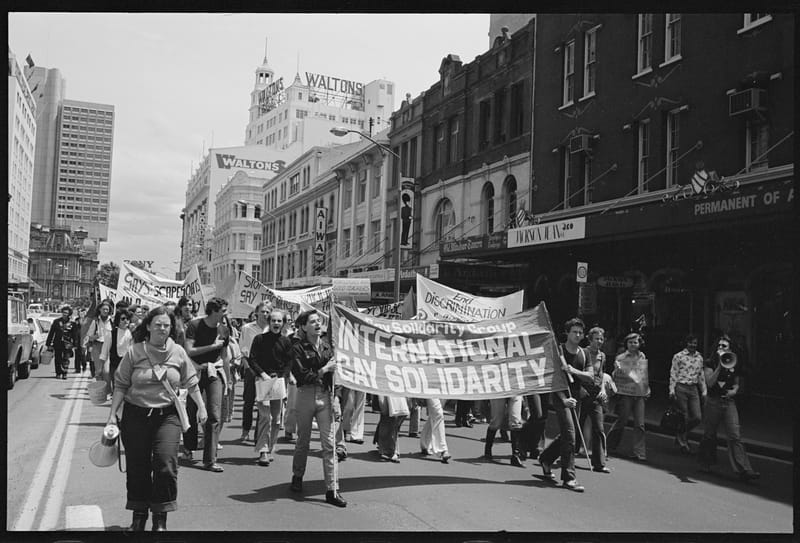
This physical disruption embodied the structural logic of Sydney's broader radical culture. In the streets, the Gay Liberation movement demonstrated what sociologist Raewyn Connell called "embodied politics." It was a nonviolent movement that bypassed abstract debate to "occupy space with bodies" in households, workplaces, and public zones.33 Bunyan, Marcus. (2014). "Nicholas Henderson - Being there Gay liberation photography in Australia 1971-73." The students imported this exact spatial tactic. Moral petitions stalled against the brick wall of the Professorial Board. But the dynamic changed the moment the students merged with working-class industrial power. Faced with material leverage that threatened the university's physical expansion, the administration capitulated and approved the course.
The university administration immediately launched a massive structural counter-attack. They knew the radical coalition was fragile—exhausted scholars fighting a multi-front war against patriarchal hostility and conservative backlash. A moderate faculty member named Keith Campbell cooked up a secession plan, and the Vice-Chancellor eagerly rubber-stamped it. They bifurcated the entire discipline. They created the Department of Traditional and Modern Philosophy to sequester Armstrong, Stove, and the conservative loyalists. They shoved the Marxists, feminists, and radicals into the Department of General Philosophy. Orthodox accounts frame this as an amicable intellectual settlement that allowed the conservatives to build "the best club in the world."34 Franklin 1999, p. 18. That is a hallucination. It was a calculated quarantine.
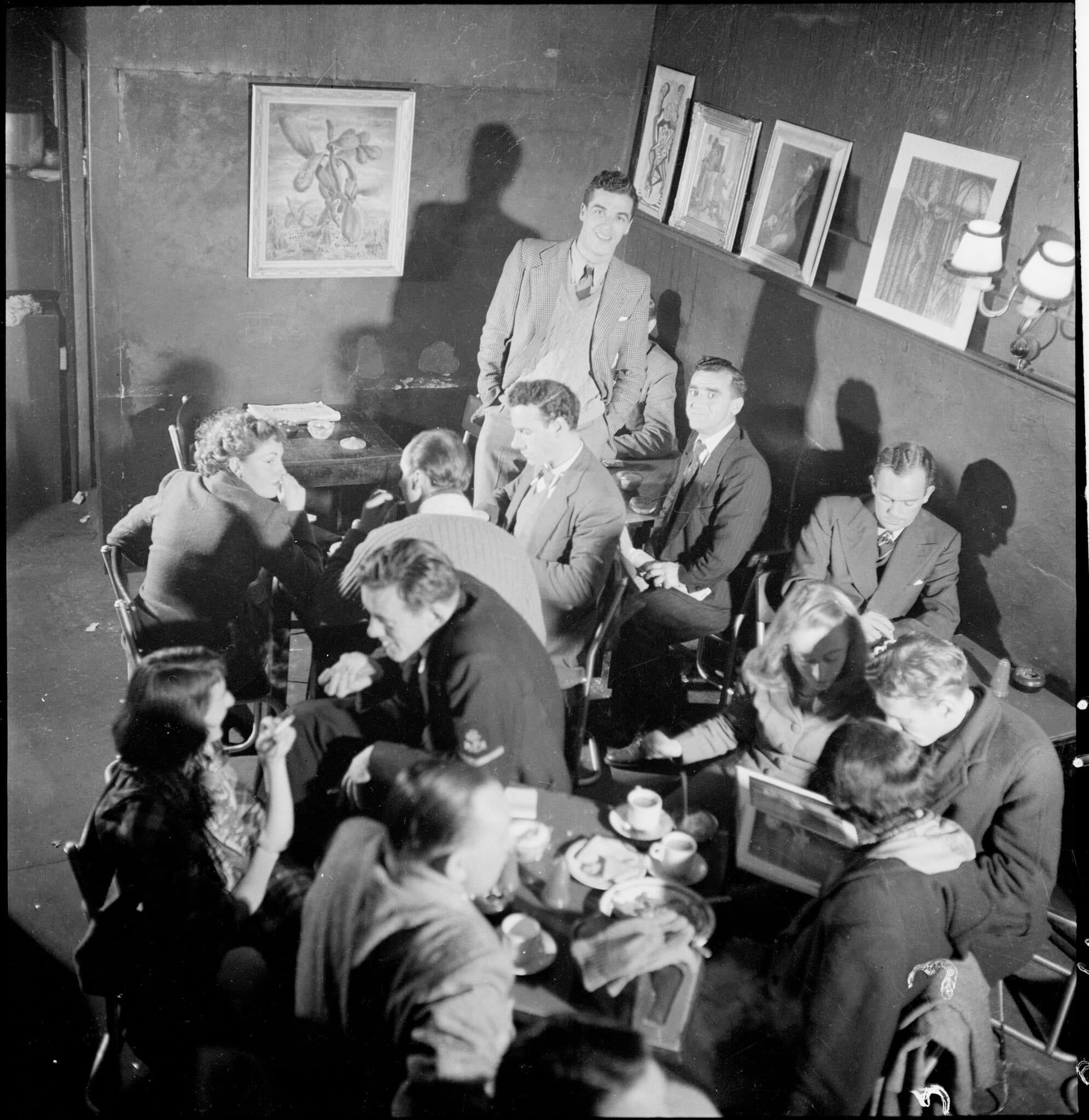
Birthplace of the Sydney Push movement. Lincoln Coffee Lounge & Cafe on Rowe Street, Sydney. Described as "a popular meeting place for artists & writers" that "comprised a mixture of university students, lecturers, Bohemians & Libertarians," c. 1948-1951 (Brian Bird @ Flickr).
We know this was an administrative trap because the university had run the exact same play a decade earlier. As Alan Barcan documents, during the 1963 "Leavisite Schism" in the English Department, the administration neutralized a radical student insurgency by segregating the curriculum into "A" and "B" streams.35 Barcan, Alan (2007). "Student Activists at Sydney University 1960-1967", p. 69. The university bureaucracy does not adjudicate claims on epistemic merit; it executes structural apartheid. By dividing departments into isolated curricular tracks, the administration insulates entrenched cartels and their patronage networks from democratic seizure. The 1973 split wasn't a compromise. It was the deployment of a tested bureaucratic weapon.
It was a brutal, gerrymandered capital preservation strategy. The administration built a firewall around its premier academic assets, then launched a campaign of total resource starvation against the radicals. General Philosophy ended up carrying 750 students. Traditional and Modern Philosophy only had 200.36 Franklin 1999, p. 19. The conservatives enjoyed almost quadruple the teaching resources per student. They secured a state-subsidized boutique sinecure, while offloading the administrative and instructional burden of mass education onto the Marxists. They bought their peace and quiet by structurally exploiting the labor of the radical department. This is the Australian Anomaly: the left fought a ground war and won the syllabus, so the right simply took the budget and built a wall.
3. Architecture of Compromise
After successfully orchestrating their administrative secession and retreating behind the walls of the Traditional and Modern Philosophy department, the conservative establishment faced an ideological crisis. You don't gerrymander a university department to protect your salary and admit it. You have to dress it up as a noble defense of Western civilization. The conservative right—led by Armstrong and Stove—set about capturing the contested legacy of Anderson. They executed a posthumous theoretical hijacking. They weaponized Anderson's "libertarian" rhetoric against the structural materialism of the Marxist vanguard they had just fled. They rebranded their state-sponsored quarantine as the last bastion of free thought. Standard histories omit that this was a fiercely contested proxy war. The radical General Philosophy vanguard actively weaponized Anderson's Socratic commitment to freethought to demand democratization. They used the establishment's foundational rhetoric to break the hierarchy. The traditionalists didn't save Anderson's legacy; they just seized the budget to protect their narrow empiricist slice of it.37 Jeffery, Renée. (2008). "An Early Influence: John Anderson", in Remembering Hedley, Palgrave Macmillan, pp. 9-29.
A conservative fortress cannot survive purely on its orthodox fumes. It needs the moral cover provided by the very people it opposes. Enter the left-liberal defectors. As the radical General Philosophy department began implementing materialist research directions, a faction of liberals who initially supported the strike experienced a crisis of nerve. Confronted with a militant Marxist vanguard that actually intended to seize the means of intellectual production—rather than talking politely over sherry—these liberals were terrified. Figures like Devitt and Curthoys staged a calculated retreat to secure tenure and academic respectability, migrating directly into the welcoming arms of Armstrong and Stove's conservative department.
The historical blueprint for this liberal defection was drafted long before the Split. During a 1944 debate, Rosenthal-Schneider mobilized Kantian idealism to defend "free inquiry" against communist physicist Richard Makinson, who argued scientific inquiry must submit to materialist planning. This invocation of pure science operated exactly as it would for later liberal defectors. It equated Marxist planning with authoritarianism, and sanctified the establishment's monopolized resources as neutral sites of objective truth. By brandishing high-minded epistemic principles, anti-authoritarian liberals provided the establishment with indispensable moral cover. They neutralized class-conscious deconstruction while shielding the bureaucratic machine from economic accountability.38 Helbig, Daniela K., and Maureen A. O'Malley (2022). "'The border problems of science and philosophy': Ilse Rosenthal-Schneider and post-World War 2 science in Australian academia and society." Historical Records of Australian Science 33(2), p. F.
When you cross a picket line to join the reactionary establishment, you must manufacture an excuse. These defectors deployed a classic ideological smokescreen. They framed their migration not as administrative capitulation, but as a heroic flight from Marxist "intolerance." Devitt later recounted that the migrating liberals jokingly referred to themselves as "Gangs," while the conservative right welcomed them as "boat people." The metaphor was a grotesque appropriation of actual Vietnamese refugees. Those civilians were fleeing the very imperialist wars Armstrong and Stove enthusiastically supported. The exchange exposes insulated bourgeois consciousness in its purest form. It transforms human casualties of state violence into an inside joke for tenured professors transferring offices.
We know this because the defectors wrote the history books. Decades later, Brian Leiter—the self-appointed administrative gatekeeper of the modern analytic profession—published a retrospective explicitly platforming Devitt's sanitized narrative.39 Leiter, Brian (2022). "When the University of Sydney philosophy department split apart for political reasons in the 1970s." Leiter Reports. Leiter claims to defend objective empirical standards. He demands an impossible burden of proof—a strict deductive entailment ($P \vdash Q$) where $P$ is the syllabus and $Q$ is capitalist production—whenever Schuringa attempts a materialist critique, instantly dismissing it as "vulgar" Marxism. Yet, his much-vaunted skepticism miraculously evaporates the second he needs to defend the conservative bloc. He uncritically platforms Devitt's curated history without forensic interrogation, laundering raw bureaucratic gatekeeping into historiography. Because Devitt possessed the sole surviving physical archive of the conflict, he systematically stripped the 1970s institutional war of its revolutionary objectives.
"Commuting to Circular Quay," 1975 (National Archives of Australia @ Instagram).
In his official telling, the ideological struggle for the syllabus is reduced to personality clashes and administrative inconvenience. Evidence of this erasure arrives when he cheerfully recalls how he and Armstrong—the arch-conservative hegemon who colluded with executives to crush the left—became good friends working across party lines over glasses of "bubbly."40 Leiter, Brian (2022). Peter Godfrey-Smith's nostalgic memoirs expose the material reality of this collegiality. He vividly describes T&M's parties, morning teas, and visits from American elites like David Lewis.41 Spiteri, Thomas (2021). "A Conversation with Peter Godfrey-Smith." Undergraduate Philosophy Journal of Australasia. This performative politeness masked the raw operation of bourgeois patronage. The traditionalists traded ideological conformity (operating under smokescreens of stylistic "clarity") for direct integration into the elite US imperial pipeline (Stanford, Princeton). This successfully starved the radical General Philosophy enclave of international academic capital.42 Godfrey-Smith, Peter (2019). "Australian philosophy". Aeon.
Applying the diagnostic framework of Herbert Marcuse's One-Dimensional Man, the function of this collegiality becomes devastatingly clear. Marcuse warned that critical thought is rarely destroyed by direct violence. It is neutralized through "repressive desublimation." The established order survives by absorbing the radical opposition.43 Marcuse, Herbert (1964). One-Dimensional Man: Studies in the ideology of advanced industrial society. Routledge, pp. 75-79. The bubbly shared between Devitt and Armstrong doesn't represent a synthesis of ideas. It represents the etiquette of the defeated. By prioritizing procedural politeness over structural change, the liberal defectors provided the establishment with a perfect ideological shield. They transformed an irreconcilable conflict over the material ownership of intellectual production into a harmless debate over syllabus diversity. The defectors subordinated their own radicalism to preserve their class interests. This ensured the analytic administration's absolute control remained intact.
Beyond merely writing the sanitized history, Devitt constructed the semantic firewall required to protect it. In his textbook Language and Reality, Devitt championed the "Causal Theory of Reference." This framework structurally outsources the meaning of words to an original historical "dubbing" event managed by recognized experts. This was a bureaucratic counter-insurgency tactic. By locking definitions into rigid causal chains, Devitt provided the theoretical justification for stripping radical students and workers of the agency to redefine their own material reality. He legally centralized semantic authority back in the hands of the professorial elite.44 Devitt, Michael and Sterelny, Kim (1999). Language and reality: an introduction to the philosophy of language.
The most spectacular liberal defection belongs to Jean Curthoys. During the 1973 strike, Curthoys was a radical vanguardist who spearheaded the original feminist curriculum, facing hostility from men who believed women were biologically incapable of philosophy. Yet, by 1997, she had completed a reactionary pivot. She published Feminist Amnesia, a masterpiece of ideological assimilation.45 Curthoys, Jean (1997). Feminist Amnesia: The Wake of Women's Liberation. London: Routledge. What drove a prominent striker into the refuge of virulent reactionaries like Armstrong and Stove? We must understand the psychological and structural violence of the academy. When post-structuralist feminists like Elizabeth Grosz began dismantling fixed categories of biological gender, they threatened the essentialist footing early feminists had fought to secure. Exhausted by territorial warfare and desperate for institutional legibility, Curthoys sought a theoretical anchor. The conservative establishment was waiting to provide it.
She fabricated a sanitized origin story for Women's Liberation. She stripped it of its militant Marxist roots, reimagining it as a spontaneous manifestation of "Socratic wisdom" and Christian love. Under pressure to legitimize her discipline to a hostile bureaucracy, she converted collective political resistance into an individualized quest for moral purity. She launched a ferocious assault on post-structuralist gender fluidity.
Curthoys deployed a historical analogy so disproportionate it reveals the defensive posture required to survive in the conservative academy: she equated the feminist deconstruction of biological essentialism directly with Soviet Lysenkoism. She argued that just as Stalin's apparatus suppressed genetic science, contemporary academic feminists were using political loyalty to suppress objective truth. The psychological transgression required to execute this maneuver is a testament to the establishment's assimilative power. Curthoys's parents were dedicated Marxist militants within the Communist Party of Australia. To secure a permanent foothold within the conservative framework, Curthoys repudiated her parents' revolutionary heritage. She weaponized a Cold War trauma to construct an anti-communist bludgeon against former allies.46 Curthoys 1997, pp. 72-88. Her appeal to "common sense" and "Socratic wisdom" functioned as a reactionary populist maneuver. It was a desperate retreat into classical liberal humanism to defend fixed biological binaries against post-structuralist fluidity.
By locking identity into an immutable biological binary ($W(x) \leftrightarrow B_f(x)$) and equating human worth with biological conformity, Curthoys provided the academic hierarchy exactly what it needed. She delivered a liberal-humanist vocabulary allowing the administration to pathologize queer theory and bodily fluidity as an authoritarian conspiracy. Crucially, her 1997 text proves the modern trans-exclusionary (TERF) blueprint wasn't engineered by the religious right. It was pioneered inside the academy by exhausted ex-radical feminists desperate to secure tenure from the traditionalist bloc. They offered up gender fluidity as a sacrificial lamb to prove their loyalty to the empirical establishment. Curthoys defended the "neat coupling" of DNA and the autonomy of pure science, shielding institutionalized knowledge from investigation into its material foundations. This was an ontological border control operation. Just as liberal property models map the Cartesian disembodied subject instrumentally onto a physical body, the conservative administration desperately needed to lock down the human subject with rigid bivalent equations to preserve their epistemological monopoly.47 Grosz, Elizabeth (1994). Volatile Bodies: Toward a Corporeal Feminism. Bloomington: Indiana University Press, p. 8. The exhausted liberal defector handed them the keys.
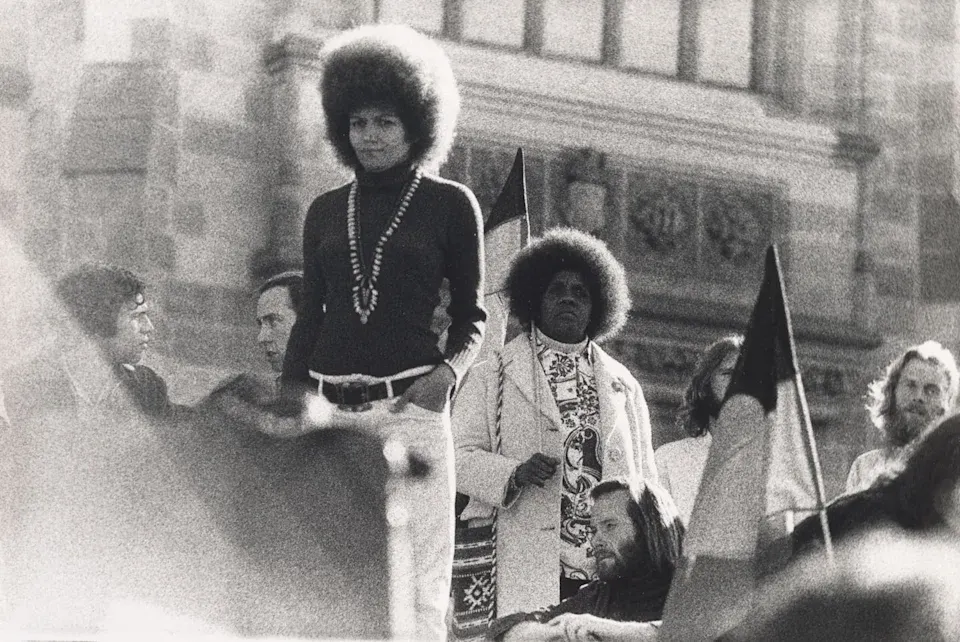
Defiance against the settler state. Collaborative portrait of Bobbi Sykes at the podium during the Black Moratorium, Sydney, 1972 (Carol Jerrems, National Gallery of Australia @ Yahoo News).
4. Post-Structuralism, the New Left, the Vanguard's Realities
When the university administration cleaved the philosophy department in two in late 1973—quarantining radical elements in General Philosophy and sheltering the traditionalist bloc in Traditional and Modern Philosophy—they didn't just build an administrative wall. They engineered a fiscal siege. Standard histories frame this bifurcation as a magnanimous compromise, a polite pluralist accommodation. That is a hallucination. It was a calculated quarantine. Vice-Chancellor Bruce Williams cordoned off the Marxists and feminists, and systematically starved them of oxygen.
The proof lies in the raw bureaucratic data recovered by Lewis d'Avigdor. By 1977, the radical enclave of General Philosophy taught seven hundred undergraduates. The traditionalists taught a paltry two hundred. Yet the administration gerrymandered the budget so severely the conservative faculty enjoyed more than double the teaching resources per student. Traditionalists sat comfortably in state-subsidized sinecures with a one-to-eleven staff ratio. They were completely insulated from student demand. Meanwhile, radicals drowned under a one-to-twenty-five ratio. They were forced to operate an experimental participatory democracy while perpetually exhausted.48 d'Avigdor, Lewis (2015). "Participatory Democracy and New Left Student Movements: The University of Sydney, 1973-1979". Australian Journal of Politics and History, 61(2).
This artificial scarcity was an administrative weapon. University executives understood a simple fiscal truth. Starving a democratic department of resources ensures it devours itself. Every hiring decision became an existential crisis. Faculty were forced into zero-sum brawls over whether their single vacancy should go to a formal logician or a feminist theorist. It was institutional sabotage masquerading as budgetary pragmatism. The liberal center loves to demand "ideological pluralism" when its hegemony is threatened. But when genuine left-wing pluralism materialized in General Philosophy, the administration rebranded it as "institutional chaos." They used this to justify shutting down the experiment. Pluralism is only permitted when it centers traditionalist authority.
While General Philosophy suffocated under this fiscal embargo, the conservative faction and their liberal defectors mounted a public relations campaign. They smeared the student body. They painted the "New Left" as totalitarian Stalinists running a campus gulag. Looking at the historical timeline, this accusation is a deliberate inversion of reality. The conservative right smears any vanguard as an authoritarian threat to the public. This rhetoric masks a basic structural truth. A vanguard is only "authoritarian" against the establishment's own unjust power. On the ground, the student movement was fiercely anti-authoritarian. These were kids holding democratic assemblies on the lawns under banners reading "Sisterhood is Powerful." They built direct, material solidarity with the working-class labor unions the administration despised.49 d'Avigdor, Lewis (2015).
The traditionalists needed a bogeyman to justify their top-down suppression. This is where the left-liberal anti-authoritarians revealed their function. Academics like Michael Devitt and John Mills briefly utilized anti-establishment rhetoric to challenge Armstrong's autocracy. But the second they had to operate inside a democratized department, they panicked. They couldn't handle defending syllabi to undergraduates or sharing voting power with part-time tutors. They drafted manifestos complaining about "intimidation" and scurried across the border to the conservative department. They didn't want a democratic university. They wanted a state-subsidized country club where their intellectual property couldn't be voted out of existence by a Marxist caucus.
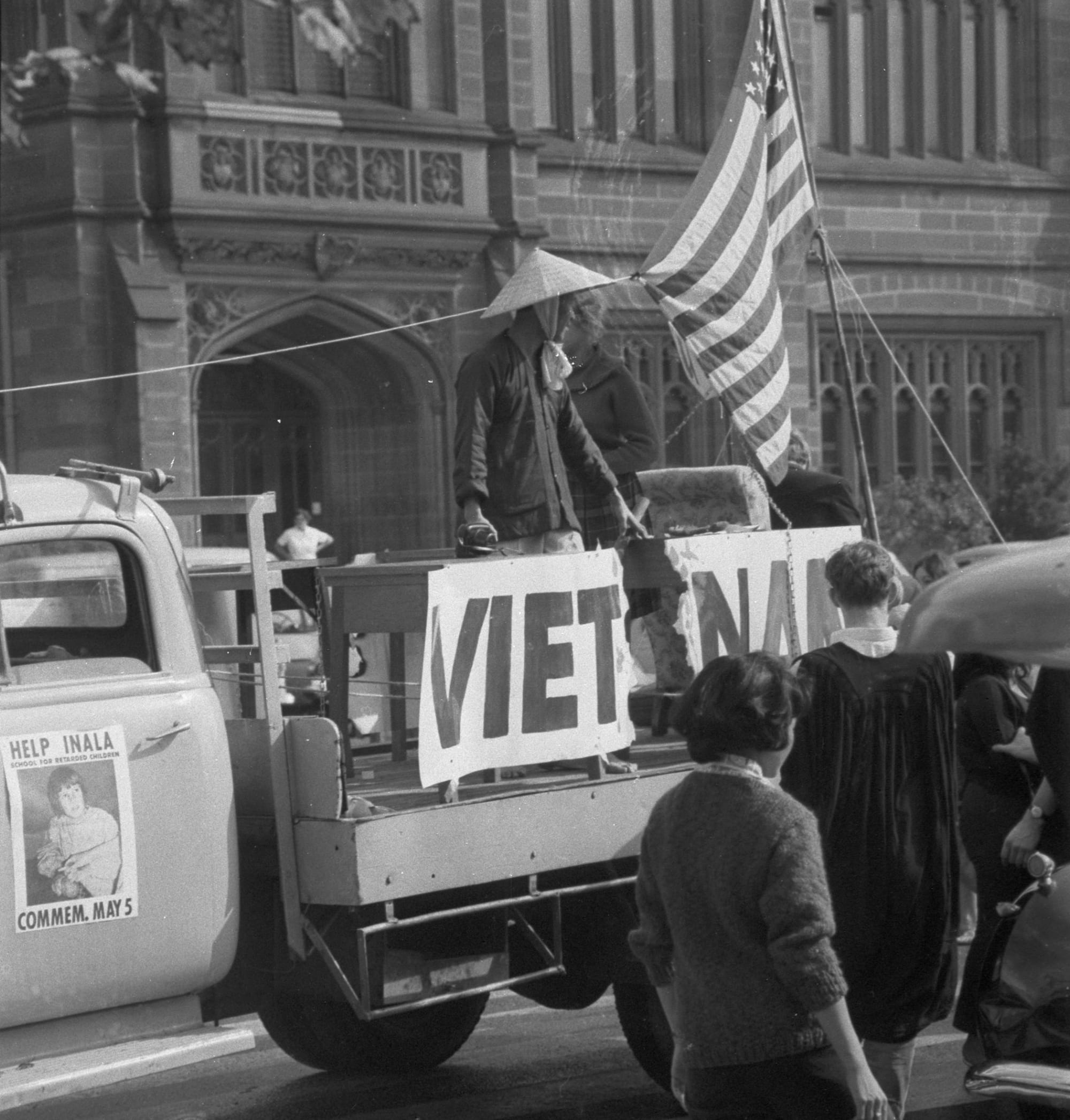
The aestheticization of protest. University of Sydney Commem Day procession at the Old Medical School. These annual processions were "noted for their witty and political floats, and festivities were often exuberant," May 5, 1965 (Jack Hickson, Australian Photographic Agency @ Flickr).
The nadir of this liberal defection crystallizes in the retrospective myth-making of commentators like Terence Blake and Levi Bryant. To justify their retreat from radical organizing, they weaponize Jacques Rancière's critique of Althusser. They defend "epistemic populism" and a "flat ontology."50 Bryant, Levi R. (2011). Althusser's Lesson. Bryant attempts to synthesize Rancière's anti-authoritarianism with a "Lacanian spirit." This is a staggering display of structural illiteracy. Rancière's project is a war against a "hidden truth" inaccessible to ordinary consciousness. That is the exact premise of the Lacanian unconscious (sujet supposé savoir). By mashing them together, Bryant neuters psychoanalysis. He transforms it into a harmless affirmation protecting bourgeois common sense. Blake and Bryant classify Althusserian science as an oppressive "master discourse." This is a cynical rhetorical sleight of hand. They pathologize structural materialism as elitist domination. This anti-scientific posture functions as an ideological clearing mechanism for the conservative administration. They demand a frictionless pluralism where theoretical rigor is condemned as authoritarianism. This strips the working class of the analytical apparatus required to map the structural causality of capitalist production.
To mask this institutional complicity, these defectors constructed absurdist melodramas of "academic exile." Blake claims his tenure in General Philosophy was "traumatic." He frames a European academic migration financed by state subsidies as a harrowing escape from Marxist totalitarianism.51 Blake, Terence (2011). Althusser's Lesson. He treats acquiring prestigious grants and long-term tutorships as evidence of victimization. The psychological fragility is staggering. Stephen Putnam, in Blake's circle, blamed his failure to produce original work on his car being stolen. Worse, these commentators expose their adolescent misunderstanding of "praxis." They mock Wal Suchting for safely operating a supply vehicle during the Rozelle terminal strike, while praising George Molnar for getting thrown into a paddy wagon. They fetishized physical danger for "street credibility." They failed to understand that Suchting was preserving the department's most vital asset from termination. They elevate banal administrative inconveniences into grand narratives of ideological warfare. It is the defining bourgeois grievance. They weaponize the aesthetic of radical dissidence to defend intellectual mediocrity while permanently abandoning the structural fight.
Conservatives were terrified of Marxists, but the feminist caucus and post-structuralist epistemologies induced total institutional vertigo. The analytical establishment built their empire on the Cartesian premise of the disembodied, objective observer. They claimed their formal logic was a universal language. They believed it was unsullied by flesh, blood, and historical time.
Then theorists such as Grosz and Moira Gatens systematically dismantled the plumbing. Grosz's corporeal feminism was a lethal strike against the establishment's foundational myth. She demonstrated the supposedly "neutral," disembodied Cartesian mind was just a specific, white male corporeal morphology projecting itself as a universal standard ($M_c \equiv U$).52 Grosz, Elizabeth (1994). Volatile Bodies: Toward a Corporeal Feminism. Bloomington: Indiana University Press, p. 19. Drawing on Lacanian psychoanalysis, Grosz exposed this "objective observer" as a linguistic symptom. The sovereign intellect was structurally deconstructed through the algebraic mapping of Metonymy ($F(S...S') \cong S(-)s$), propelling the endless sliding of desire, and Metaphor ($F(S'/S)S \cong S(+)s$), establishing the symptomatic speaking subject.53 Grosz, E. (1990). Jacques Lacan: A feminist introduction. Routledge. Traditionalists didn't just code the body and nature as feminine to win debates. They did it to exclude women from the payroll. By asserting true knowledge requires disavowing the body, the conservative establishment constructed a perfect, self-sealing gatekeeping mechanism. Anyone pointing out the material realities of patriarchal power was dismissed as an irrational intruder violating the sacred geometry of pure reason.
This is why traditionalists pathologized post-structuralist deconstruction as a dangerous "anti-science" contagion. It wasn't just disagreeing with Lacan or Foucault. The post-structuralist framework threatened the biological and logical grid the administration relied upon to distribute university funding. If knowledge is an effect of bodily inscription and institutional power, the analytical claim to objective detachment is exposed as a massive bureaucratic fraud.
Looking south down George Street from the Bathurst Street corner at night, featuring the now-demolished Regent Theatre on the right, c. 1940s-1950s (Taken by the father of dabblewit @ Flickr).
Trapped inside this hostile architecture, fighting a two-front war against conservative starvation and liberal defection, the Marxist vanguard adopted a strategy of absolute militancy. This brings us to Wal Suchting. The defectors painted Suchting as a dogmatic dictator ruling the department with an iron fist. The material reality was entirely different. Suchting was operating as an Althusserian Machiavel, throwing dice into an institutional void.
Suchting understood that philosophy is class struggle in the field of theory.54 Suchting, Wal (2004). "Althusser's Late Thinking About Materialism". Historical Materialism, 12(1), pp. 56–58. He recognized the liberal ideal of the university as a neutral marketplace of ideas was a lethal illusion. You cannot have a polite debate with an apparatus actively gerrymandering your budget and collaborating with state intelligence to surveil your students. To survive, the vanguard couldn't rely on bureaucratic channels. Those were captured territory programmed to reproduce dominant ideology.
Instead, Suchting and his allies—John Burnheim, Ted Sadler, George Molnar—engaged in the necessary work of drawing theoretical "lines of demarcation." Crucially, Suchting didn't retreat into a simplistic refusal of formal logic as "bourgeois." He didn't abandon math. He proved the administration's math was obsolete. Suchting recognized Anderson and Armstrong's logic was trapped in archaic, static Aristotelian abstraction ($AaB$). It was unable to map dynamic material change. Suchting overcame traditional logic by deploying modern algebraic syntax. He argued modern scientific concept-formation doesn't delete material differences to find a static essence. It maps differences structurally and relationally.
Just as modern analytic geometry uses a generative equation ($Ax^{2}+2Bxy+Cy^{2}+2Dx+2Ey+F=0$) dictating structural possibility space, which can be parameterized into a concrete instance like an ellipse ($x^{2}/p^{2}+y^{2}/q^{2}=1$), the Marxist vanguard insisted on functional, relational concept-formation.55 Suchting 2004, pp. 48–49. Suchting mathematically modeled Marxist contradiction as a dynamic systemic driver ($f(t) = \{C(t) \leftrightarrow L(t)\}$). He integrated the brutal kinetic realities of capital and labor. This advanced syntax proved the Marxist framework was logically superior to the establishment's primitive object-counting. The intense factionalism characterizing General Philosophy wasn't a symptom of intellectual dysfunction. It was the agonizing result of running a genuinely democratic, materialist enclave inside a hostile university apparatus. They weren't fighting over abstract dogma. They were fighting for the existential survival of a department the administration had pre-programmed to fail.
Yet the conservative faction cynically weaponized this internal friction, manufacturing the enduring smear that the Marxist vanguard was an "autocratic" mob. We see exactly how this propaganda was laundered through the retrospective account of Kalpana Ram, an Indian postcolonial feminist who arrived at Sydney in 1973. Ram recounts an Althusserian supervisor dismissing Marxist-Feminism as a "regional" problem.56 Ram, Kalpana (2025). "A Feminist Postcolonial Journey: Moving Between Countries, Academic Disciplines and Institutions". History of Anthropology Review. In strict Althusserian epistemology, "regional" denotes a specific structural domain beneath the general theory of dialectical materialism. It is a standard taxonomic categorization. Lacking institutional power, vulnerable actors like Ram internalized this boundary-drawing as patriarchal suppression, inadvertently carrying the administration's ideological water. The traditionalist bloc forced marginalized scholars to launder their reactionary smears, weaponizing standard democratic factionalism to justify administrative purges.
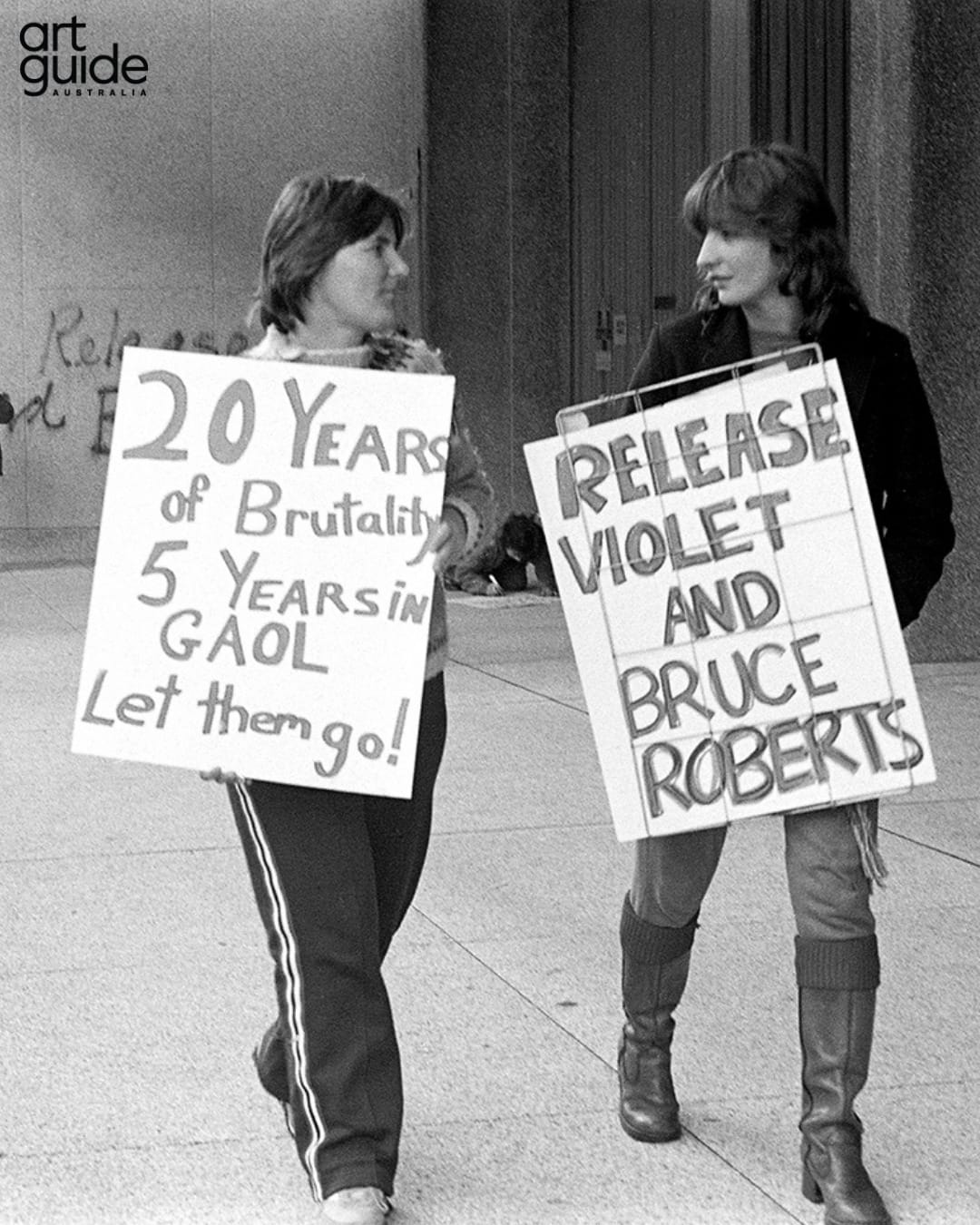
"Justice for Violet and Bruce." The photo documents the Women Behind Bars movement demanding the release of a mother and son convicted of murder after enduring severe domestic abuse that was omitted by the court, 1980 (Photo by Helen Grace, shared by Art Guide Australia @ Instagram).
5. Epistemological Gatekeeping
The traditionalist bloc could not defeat the Marxist dialectic on a logical playing field. They built an epistemological border wall to ban it entirely. They found their primary weapon in G.E. Moore. In 1925, Moore decided the highest form of philosophical truth was his own bourgeois "common sense." He sat in a chair, looked at his hand, and declared empirical immediacy the only valid reality.
This was the perfect administrative weapon. The analytic faction weaponized their own incomprehension to maintain power. A.J. Ayer dismissed Jean-Paul Sartre's existentialism simply by claiming it was "very difficult to follow." They equated their refusal to engage with structural critique as a failure of the critique itself.57 Vallelly, Neil (2025). "Analytic Philosophy Is a Dead End for the Left." Jacobin. When Wal Suchting introduced dialectical materialism at Sydney, the establishment pulled the exact same move. The dialectic requires looking beneath empirical reality to track hidden capital flows. The administration just pointed to Moore's "common sense," declared the dialectic a logical violation, and moved to shut the left down.
But you can't just call the administration and say, "Fire the Marxists because I don't want to read their complicated books." You need a moral cover story. Here, Cold War liberals provided a crucial service: the "anti-totalitarian" smokescreen. The establishment constructed a narrative equating Marxist planning with fascism. Framing the defense of bourgeois liberalism as resistance against "totalitarianism" provided the moral alibi for McCarthyist administrative purges. They didn't want to stop fascism. They wanted to decouple their methodology from the material conditions of its reproduction. They secured tenure by actively participating in the domestication of radical capital.
You see this domestication most clearly in the intellectual fraud known as "Analytical Marxism." In the 1980s, figures like G.A. Cohen, Jon Elster, and John Roemer realized they could maintain lucrative positions within the analytic establishment. They just had to strip historical materialism of its working-class agency. They mandated "methodological individualism" and imported game-theoretic modeling derived from Cold War defense think tanks. They took the brutal kinetic reality of capitalist exploitation—the physical violence of the factory floor, the tear gas, the smashed picket lines—and modeled it as a polite interaction between idealized "rational actors" with axiomatic preference sets.
Today, apologists like Nick French and Dominick Cooper are desperately trying to salvage this bourgeois methodology.58 French, Nick (2025). "Is Analytic Philosophy a Class Ideology?". Jacobin.59 Cooper, Dominick (2025). "Review of Schuringa". Radical Philosophy. They claim they can "decouple" the analytic method from liberal ideology. They pretend the tool itself isn't structurally programmed to reproduce capitalist relations. It is a pathetic professional survival mechanism, rehabilitating a framework Joshua Pineda diagnosed as "the same bullshit in a new bottle."60 Pineda, Joshua Nicholas (2023). "Dilemmas of Analytical Marxism: Old Wine, New Bottle". Spectre. Laundering the procedural grammar of elite academic gatekeepers, French and Cooper provide a deflationary alibi. They offer cover for left-leaning faculty who desperately want to cling to a radical aesthetic without jeopardizing their university healthcare plans.
The technological acceleration of capital. A Concorde Prototype at Sydney Airport, 1970s (John Arkwright @ Reddit).
Look what happens when liberals try to fix the math. Rod O'Donnell attempted to secure Marx against Neoclassical economics. He walked right into the institutional trap, serving as the perfect counter-example to Suchting's triumph. Neoclassicism uses Mathematical Logic (ML) to construct ideal axiomatic sets ($S = \{A_1, A_2, \dots, A_n\}$), demanding formal derivations resulting in perfection ($S \vdash \text{Equilibrium}$). When the math inevitably fails to describe reality, they patch anomalies by manually forcing empirical reality back into the set ($S' = \{A_1, \neg A_1, \dots, A_n\}$). This creates a catastrophic propositional failure. The system now contains a direct contradiction ($A_1 \land \neg A_1$). In classical logic, introducing a contradiction triggers the "Principle of Explosion" ($A_1 \land \neg A_1 \rightarrow \bot$). This means from a single contradiction, absolutely any statement can be proven.
Terrified of this explosion, O'Donnell offered a cowardly, defensive retreat. His solution was to strictly enforce safe, co-existing Aristotelian "contraries" using Propositional Logic (PL) just to avoid the math breaking down.61 O'Donnell, Rod (2025). The Importance of Philosophy to Political Economy: Reflections and Proposals. Routledge. But this administrative band-aid explicitly outlaws the Hegelian-Marxist syntax where contradiction is the actual kinetic driver of historical change. By trying to make Marx mathematically polite for the analytic establishment, O'Donnell structurally neutralized the materialist focus on systemic rupture. He saved classical logic by murdering the revolution. This is why Suchting's approach in Sydney was revolutionary. Suchting didn't protect Marx by castrating the dialectic to fit static Aristotelian boxes. Suchting used modern parametric relational logic ($Ax^{2}+2Bxy+\dots$) to prove that contradiction ($C(t) \leftrightarrow L(t)$) doesn't explode a system—it is the generative engine that structures it. When you use dynamic mathematics, the materialist left wins. When you capitulate to the establishment's primitive syntax like O'Donnell, you become just another HR manager for capital.
The absolute pinnacle of institutional domestication belongs to Leiter and Jaime Edwards. In 2025, they published a commercial textbook simply titled Marx. It is a masterpiece of ideological defanging. They surgically extract the Labor Theory of Value. They map proletarian consciousness seamlessly onto neoclassical "rational actors." Finally, they propose the bourgeois defeatism of the "Elysium Scenario."62 Leiter, Brian and Edwards, Jaime (2025). Marx. Routledge. This sympathetic neutralization is incredibly lucrative. It converts revolutionary praxis into safe, tenure-compatible sociology and a revenue-generating commodity for the academic hierarchy.
When you strip away the high-minded rhetoric, the objective "View from Nowhere" is exposed as a localized, paranoid artifact of Cold War liberalism. The establishment retreated to what George Reisch documented as the "icy slopes of logic." It was the cognitive corollary to the closing of the political universe.63 Reisch, George A. (2005). How the Cold War Transformed Philosophy of Science: To the Icy Slopes of Logic. Cambridge University Press.64 Marcuse, Herbert (1964). One-Dimensional Man: Studies in the ideology of advanced industrial society. Routledge, pp. 21-58. Bruce Wilshire called it "fashionable nihilism," but it's much worse.65 Wilshire, Bruce (2002). Fashionable Nihilism: A Critique of Analytic Philosophy. State University of New York Press. It is a highly successful bureaucratic business model. Look at the sociological artifacts of their consolidation: the Philosophical Gourmet Report and the restructuring of elite doctoral programs like NYU. Wilshire correctly identifies the administration stripped out historical and foreign language requirements purely to mass-produce standardized, hyper-perishable "analytic gems" to game administrative rankings. The philosopher was transformed into a specialized technician servicing the institution's economy. The conservative bloc isolates epistemic methodology from political power, dismisses structural analysis as "vulgar" ignorance, and relies on sentimental biographical anecdotes to obscure that their formalist language analysis functions strictly as an ideological defense mechanism for advanced capitalism. When critics point this out, the establishment deploys Ludlow's "kumbaya trap," demanding analysts and continentals unite against the "Dark Enlightenment." It is a blatant hegemonic assimilation tactic. The dominant faction demands political solidarity against external threats while absolutely refusing to surrender a single dime of the material machinery that guarantees their continued supremacy.
6. Pluralism, or, Rorty's Ambiguous Legacy
Let's look at Richard Rorty, the ultimate test case for what happens when a liberal defector achieves an absolute theoretical victory but refuses to seize the institutional plumbing. Rorty functioned as a credentialed saboteur deep inside the Princeton philosophy department. He took the internal logic of the analytic establishment's own heavyweights—Wilfrid Sellars and W.V.O. Quine—and weaponized it against them. He completely collapsed their foundationalist claims. He proved the analytic obsession with the "mirror of nature" wasn't a defense of objective truth. It was a massive bureaucratic power grab designed to secure a permanent, neutral framework to judge culture and control the syllabus.66 Rorty, Richard (1979). Philosophy and the Mirror of Nature. Princeton: Princeton University Press. But what did Rorty actually do with this massive structural victory? He surrendered immediately.
The logistical periphery. Long Nose Point, 1970 (Wilford Peloquin @ Flickr).
He didn't want to dismantle the institutional apparatus. He just wanted to change its vocabulary. He pioneered a pathetic framework called the "liberal ironist." He told the left to abandon historical materialism, stop trying to seize the means of production, and focus on aestheticizing our language to reduce interpersonal cruelty. It was a total ideological capitulation.67 Madelrieux, Stéphane (2023). "Richard Rorty the Multi-Pragmatist." Rorty explicitly viewed academics as a "parasitic priestly class which confers sacraments like BAs and PhDs." He privately admitted the purpose of his project was to swing students slightly left while deploying "claptrap about contemplation." This was designed to prevent a material revolution that might threaten his bourgeois comfort.68 Cahoone, Lawrence (2021). "The Pluralist Revolt: Forty Years Later." Philosophy Today 65(3), p. 762. The Professional-Managerial Class (PMC) absolutely devoured this. It allowed university administrators and HR managers to perform radicalism by policing cultural vocabularies while keeping their massive salaries intact. Rorty successfully transformed a structural war for resources into a polite literary salon.
We see the mechanical function of this liberal defection by comparing the Sydney Split to the American "Pluralist Revolt" of 1979. Over in Australia, the Marxist vanguard and radical feminists allied with liberal defectors like Devitt and Curthoys. But the vanguard maintained control of the objective. They struck, they occupied the quadrangle, and they physically forced the university Senate to bifurcate the department. They successfully seized a massive chunk of institutional funding for General Philosophy. They won an actual material ground war.
In the United States, marginalized philosophers tried to play by the rules of the establishment. Lawrence Cahoone wrote a forty-year retrospective on this conflict, framing a bureaucratic monopoly as a harmless biological instinct. He claims philosophers naturally segregate like birds flocking to nests: "birds of a feather prefer to flock together."69 Cahoone 2021, p. 748. This biological framing is an ideological fraud. An institutional faction doesn't achieve monopoly control over 150 doctoral programs through natural preference. It secures dominion by systematically seizing hiring committees, capturing journal editorial boards, and using state-accrediting agencies to threaten the funding of dissenting departments.
That is exactly what triggered the American revolt. In 1977, the analytic establishment used a New York state accrediting committee—which actually included a young Richard Rorty—to put the New School for Social Research on probation, threatening its existence simply because it lacked "analytic" representation. Faced with administrative extinction, the continentalists and pragmatists formed the "Saturday Group." They launched a procedural insurgency within the American Philosophical Association (APA). At the 1979 Eastern Division meeting, they forced a public reading of nomination tallies. They proved the analytic establishment's hand-picked candidates didn't have democratic support. The pluralists mathematically won the election, placing John Smith into the presidency.70 Cahoone 2021, pp. 752-753.
Did the analytic establishment politely accept this democratic outcome? Of course not. Ruth Barcan Marcus—operating as the procedural enforcer of the traditionalist bloc—immediately launched a jurisdictional challenge. She attempted to invalidate the election by claiming unauthorized graduate students had voted. The following year, the analytic establishment dropped the mask completely. They circulated an open letter signed by past APA presidents, warning the pluralists were attempting to obtain "through political means a position of influence which its members have not been able to through their philosophical work."71 Cahoone 2021, p. 754.
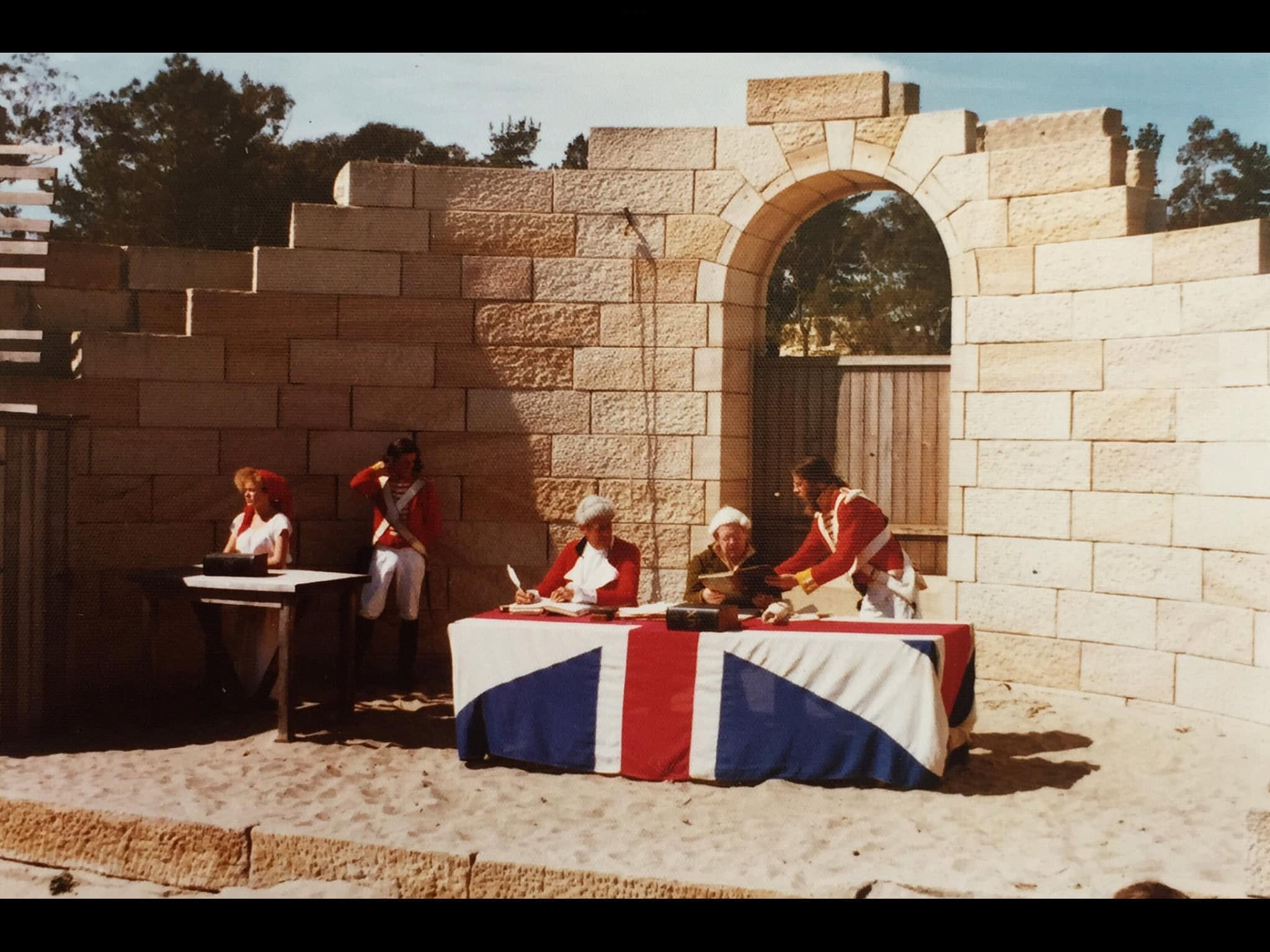
Old Sydney Town. While radicals theorized a libertarian escape from state control, the literal artifacts of colonial rule remained stubbornly present—repackaged as weekend entertainment, 1970s (David Williamson @ Facebook).
Do you see the breathtaking hypocrisy? The analytic faction built its entire empire utilizing McCarthyist purges, GI Bill technocracy, and state accreditation threats. They spent three decades engaging in ruthless political warfare. But the second a coalition of marginalized scholars organized a democratic voting bloc, the establishment rebranded procedural organizing as an illegitimate political corruption of academic merit. The administration defines its own institutional dominance as the natural outcome of objective truth. It defines any resistance to that dominance as a political crime.
This is where Rorty's role as a liberal buffer becomes devastatingly clear. As the sitting APA president during the 1979 revolt, Rorty technically validated the pluralist election victory. But he refused to lead a structural offensive. Unlike Wal Suchting at Sydney, Rorty didn't want to fracture the apparatus. He wanted to initiate an "ethics of philosophical conversation."72 Madelrieux, Stéphane (2023). "Richard Rorty the Multi-Pragmatist." He wanted everyone to realize their vocabularies were contingent. But you cannot have a contingent conversation with a bureaucracy actively trying to defund your doctoral program. By demanding pluralist conversation instead of material partition, Rorty and the American insurgents left the underlying administrative machinery entirely in the hands of the analytic establishment. They won a single election, but they lost the war.
And the consequences of that failure define the modern university. The analytic establishment proved that if you surrender the institutional plumbing, the administration will simply reallocate the capital. Today, university executives enforce a brutal bifurcation of labor that perfectly serves neoliberal economics. They funnel massive financial investment into STEM fields, economics, and quantitative psychology. Those disciplines produce the technical innovations and data algorithms required by corporate capital. The humanities and philosophy departments, systematically stripped of any capacity to intervene in material production, are repurposed as ideological service centers.
Administrators commodify moral and political signification, packaging "meaning" and identity politics to attract undergraduate tuition dollars from the professional-managerial class. The modern philosophy department becomes a consumer playground where students purchase generalized symbolic-analytic skills wrapped in the affective branding of political resistance. Cahoone laments this, longing for a return to pure, non-political contemplation.73 Cahoone 2021, pp. 761-763. But that is a bourgeois illusion, and Wilshire's own Pluralist manifesto, Fashionable Nihilism, perfectly demonstrates why the American revolt failed. To combat the analytic establishment's scientism, Wilshire retreated into a harmless "pastoral phenomenology." He obsessed over William James and found his "inward morning" alongside leaping steelhead trout. By doing so, the Pluralists actively accepted the bourgeois division of academic labor. They surrendered the rigorous structural domain to the analytic bloc and settled for acting as a therapeutic, emotional shock absorber for alienated intellectuals. Institutional philosophy has always been subsidized to perform a structural function. During the Cold War, it functioned as technocratic rigorism to sanitize the academy. Today, it functions as commodified moral signification. The Australian Anomaly proved the only way to break this cycle is to stop flocking, stop retreating into pastoral consolation, and start seizing the budget.
7. Representation
The tragedy of the post-Sydney era is that the fierce materialist feminist vanguard that emerged from the split—spearheaded by Grosz, Gatens, and Genevieve Lloyd—was bypassed by a highly sanitized, globalized version of liberal feminism. Crucially, this is not a failure of feminist thought, but a triumph of the administrative machinery. The administration deliberately defunded structural materialists while elevating HR-friendly liberals willing to play by the establishment's rules. Modern liberal feminism hasn't merely abandoned the material struggle for the means of intellectual production. It actively whitewashes the vicious institutional combat that secured its own existence.
Look at the grotesque historiography produced by contemporary philosophers like Tom Dougherty, Samuel Baron, and Kristie Miller. In 2015, they published a quantitative study explaining why female students were leaving the Sydney philosophy department.74 Dougherty, Tom, Samuel Baron, and Kristie Miller (2015). "Why do female students leave philosophy? The story from Sydney." Hypatia. Their conclusion? They blamed "pre-university gender schemas." They weaponized HR sociology to argue women arrived at university with internalized biases steering them away from the "rigorous" logic of philosophy. This is staggering academic fraud. They executed a complete historical erasure of the documented biological determinism the senior faculty actively deployed for decades. They completely ignored Stove's vicious 1990 campaign, The Intellectual Capacity of Women, which targeted Lloyd's historic professorial appointment by arguing women were biologically unfit for elite intellectual work.75 Stove, David (1990). "The Intellectual Capacity of Women." Proceedings of the Russellian Society. Dougherty and colleagues didn't want to admit the department bled women because the men running it were actively hostile. They blamed the victims for bringing the wrong "schemas" to campus. It is the perfect bureaucratic absolution.
How did the liberal feminist establishment react to Stove's misogynist crusades? With horrifying bourgeois collegiality. When Jenny Teichman responded to Stove's attack on Lloyd, she correctly identified his logical failures, mocking his modal fallacy as modus morons.76 Teichman, Jenny (2001). "The Intellectual Capacity of David Stove." Philosophy. But instead of demanding his administrative removal for cultivating a hostile environment, Teichman engaged in the polite etiquette of the defeated. She reframed his militant anti-egalitarianism as an eccentric, "delightful jokiness." This is exactly how the establishment survives. By politely correcting the formal syllogisms of right-wing extremists while excusing their political intent as "harmless" provocation, liberal commentators abandoned Lloyd to the wolves. They provided vital institutional insulation to conservative power structures. They ensured the supremacy of the patriarchal bloc remained completely unchallenged. The problem isn't that these liberal feminists couldn't spot the fallacy. It's that the academic apparatus rewards neutralizing the political threat rather than destroying it.
To understand the magnitude of this capitulation, we must look at the structural mechanics of the original feminist insurgency at Sydney. When Lloyd wrote The Man of Reason, she didn't just point out there were fewer women in philosophy. She forensically dismantled the analytic establishment's foundational myth: the claim that their method was a pure, gender-neutral, objective mirror of reality. Lloyd proved the Cartesian ideal of the "Sexless Soul" was a bureaucratic gatekeeping tool.77 Lloyd, Genevieve (1993). The Man of Reason: 'Male' and 'Female' in Western Philosophy. 2nd ed. London and New York: Routledge, pp. xiii–xvi, 49–51. Descartes separated pure intellect from bodily mechanics, requiring total detachment from everyday material maintenance. The analytic administration weaponized this. They claimed the realm of pure theoretical logic, assigning the material and administrative labor of the university to junior staff and women. If you challenged this division of labor using Marxist or feminist theory, the bloc branded you an irrational intrusion of bodily contingency into the realm of pure intellect.
The modern liberal feminist does not challenge this Cartesian division. Instead, they rely on the liberal property model of the self. Grosz isolated the exact pathology: liberalism reduces the body to property, owned by a willful, disembodied subject.78 Grosz, Elizabeth (1994). Volatile Bodies: Toward a Corporeal Feminism. Bloomington: Indiana University Press, p. 8. This allows liberals to treat political struggle as a polite contest over legal permissions and HR semantics within an abstract arena. The modern feminist academic appeals to the moral conscience of administrators, asking for representation within the existing hierarchy. This is exactly what Hegel prescribed. As Lloyd notes, Hegel relegated women to the "nether world" of the family, allowing them to authenticate the public statehood of men through a doctrine of "complementarity."79 Lloyd, Genevieve (1993). The Man of Reason: 'Male' and 'Female' in Western Philosophy. 2nd ed. London and New York: Routledge, pp. 80-84. Today's administration uses this exact Hegelian containment strategy. They create specialized, underfunded departments for gender studies and decolonial theory—an academic nether world. This allows the university to brand itself progressive and diverse, while core economic funding, STEM endowments, and institutional power remain completely in the hands of the neoliberal capitalist machinery.
The original Sydney feminists rejected this vicarious selfhood. Grosz used Spinozist monism and Nietzschean genealogy to prove knowledge is not discovered by a detached mind; it is an effect of bodily forces and institutional inscription.80 Grosz 1994, 10–13, 115–126. She recognized the university operates like Kafka's penal colony. It brands its laws directly onto the flesh of the academic, producing a docile body conforming to peer-review surveillance and bureaucratic rewards. You cannot equalize this system through moralizing appeals for tolerance. The Sydney feminists understood intellectual production is an act of physical and institutional warfare. They allied with the Marxist vanguard to seize the department. They demanded student-staff parity and the abolition of traditional grading hierarchies. They understood power operates through the direct material constitution of subjects.
This radical history is actively being overwritten by modern institutional historiography. Even liberal texts like Helbig and O'Malley's (2022) study of border problems execute a catastrophic historical erasure. They blithely assert the University of Sydney philosophy department did not award a permanent lectureship to a woman until the 1990s. This is an administrative fraud. It ignores the precise structural division of labor during the 1973 strike, completely deleting the permanent academic appointments won by these women within the democratized General Philosophy department. When the university apparatus eventually forced the reunification of the two departments, they institutionalized the exclusionary hiring timeline of the conservative Traditional & Modern department. They declared it the definitive, "official" history of Sydney philosophy, retroactively stripping the democratic enclave of its existence. This is how the bureaucratic machine operates. It extracts foundational pedagogical labor—just as it used Rosenthal-Schneider to teach the history of science for two decades before physically destroying her library upon her death. It then systematically incinerates the historical actors who produced that labor. It preserves only narratives that reproduce its own hierarchical dominance.81 Helbig, Daniela K., and Maureen A. O'Malley (2022). "'The border problems of science and philosophy': Ilse Rosenthal-Schneider and post-World War 2 science in Australian academia and society." Historical Records of Australian Science 33(2), pp. E.
Jacques Derrida's law is absolute. There is no political power without control of the archive. During the blackout years, radical factions—like the Gay Liberation movement in Sydney—could only survive by constructing decentralized, editor-less parallel infrastructures (like CAMP Ink) to distribute knowledge.82 Bunyan, Marcus. (2014). "Nicholas Henderson - Being there Gay liberation photography in Australia 1971-73." The Marxist and feminist vanguard in the philosophy department had to rely on identical ground-level distribution when locked out of Anderson's monopolized journals. The university administration understood this perfectly. By seizing control of the "official" historical archive during the departmental reunification, the bureaucracy didn't just win a debate. They secured a permanent political victory by erasing the very taxonomy of the opposition.
How did we lose this militant materialist edge? We can trace the collapse through Paul Patton's Deleuzian mapping of the academic socius. Patton demonstrates the militant Marxist vanguard operated as a "nomadic war-machine," attempting an absolute deterritorialization of the university's rigid, striated space. But capitalism and its institutional State-forms are incredibly resilient. They survive by capturing and "axiomatizing" dissent. When radical forces threatened the total destruction of the analytic bloc, left-liberal anti-authoritarians (like Michael Devitt and Jean Curthoys) stepped in as a systemic buffer. They mediated the conflict, translating the demand for total structural overhaul into a palatable administrative compromise: the bifurcation of the department. This axiomatization functioned as a relative deterritorialization. It allowed the administration to conjugate the radical flow. They placed the war-machine into a designated spatial boundary (General Philosophy), where it could be systematically starved of funding over the next thirty years.83 Patton, Paul (2000). Deleuze and the Political. Routledge, pp. 101-110.
This external capture was exacerbated by the vanguard's own strategic choices, as diagnosed by George Márkus. The Marxist vanguard adhered to a strict Althusserian "schema of rupture," anchoring their critique in the structural mechanics of Capital. However, this theoretical rigor inadvertently separated them from the broader student base, which mobilized around the early-Marxist concept of "radical needs." By focusing so heavily on the correct structural articulation of the conflict, the vanguard occasionally treated the department like a theoretical seminar rather than a contested factory floor. This left them structurally vulnerable when the conservative faction executed its administrative secession.84 Markus, George (1980). "Four Forms of Critical Theory: Some Theses On Marx's Development".
Sydney Easter Show. The signage features an advertisement for Uncle Sam deodorant next to an "Astro Graph" novelty machine, which sold horoscopes disguised as high-tech electronic character analysis, 1974 (Arthur Georgeson @ Flickr).
Locked out of traditional institutional hierarchies and starved of funding, the radical vanguard embarked on what Patton describes as a "rhizomatic retreat." In his retrospective, Patton documents how radical scholars increasingly embraced Deleuzian "outward facing" philosophy as a strategic response to changing economic dynamics.85 Patton, Paul. "How Philosophy Became Outward Facing." This was not simple capitulation. It was a dialectical adaptation to the neoliberal university. Denied access to the "arborescent" power centers of the traditional department, exiled radicals generated a highly tradable, cosmopolitan intellectual currency. By focusing on mobile concepts and applied metaphysics that could interface with literature and sociology, they bypassed localized conservative blockades and secured international mobility. However, this tactical pivot ensured their professional survival at a massive cost. They abandoned the direct, material struggle for the core economic machinery of the university.
Contemporary decolonial and liberal feminist theory fully internalized this shift. They fetishize the Deleuzian "line of flight" and molecular micropolitics, believing unanchored resistance and continuous rhetorical variation are inherently liberatory. This is a fatal mechanical failure. Patton's post-Althusserian synthesis proves advanced algorithmic capitalism operates as a superior force of deterritorialization.86 Patton, Paul (2000). Deleuze and the Political. Routledge, p. 102. Karen Rodriguez maps the historical execution of this logic. The architects of the neoliberal counter-revolution actively absorbed the New Left's demand for "participatory democracy" and "individual autonomy," explicitly stripping these concepts of their socialist economic foundations.87 Rodriguez, Besenia (2018). "Participatory Democracy and the New Left". Capital weaponized the students' critique of rigid bureaucracy to dismantle the welfare state and destroy organized labor. They repackaged the radical demand for liberation into the atomized precarity of gig-labor and extreme market deregulation. Tech monopolies and corporate HR departments now effortlessly capture these unanchored molecular flows, commodifying revolutionary aesthetics and conjugating marginalized identities into surplus value. Modern decolonialism thinks it is dismantling the master's house by changing the syllabus. It is actually just performing the preliminary decoding work for the capitalist axiomatic.
The Sydney Split proved you cannot survive a war of attrition with a purely molecular war-machine. To combat the global capitalist axiomatic, resistance must leverage the mechanics of the State-form. You need a vanguard party functioning as a mechanism of counter-capture. You must deploy rigid segmentarity to erect striated space against the infinite extraction of digital capital. The original Sydney radicals didn't ask the administration to decolonize their vocabulary. They launched strikes, occupied buildings, and seized the budget. Until modern radical theory discards its liberal idealism and returns to the raw mechanics of institutional leverage, it remains nothing more than commodified moral signification for the professional-managerial class.
This commodification is perfectly embodied by Lewis d'Avigdor, the archetype of the Westernized decolonial theorist. An academic who built his credentials validating the administrative suppression of a radical Marxist vanguard now occupies a position in Indigenous Studies. This is raw academic opportunism. In his history of the Sydney split, d'Avigdor operates as an administrative stenographer, laundering the reactionary grievances of tenured defectors into official scholarship. He outsources his entire structural analysis to the retrospective testimony of figures like Curthoys. He uses their ideological exhaustion to justify the administration's suppression of the democratic experiment. When the Marxist caucus established competing left frameworks, d'Avigdor echoed the university administration. He branded it "chaos" and referred to radical students as "lunatics."88 d'Avigdor, Lewis (2011). Let the Lunatics Run their Own Asylum: Participatory Democracy at the University of Sydney, 1960-1979. University of Sydney (Honours thesis). He weaponized "pluralism" exclusively to shut down participatory democracy. He proved the liberal academic center only tolerates decolonial aesthetics when strictly subordinated to traditionalist bureaucratic authority.
This liberal academic betrayal forms a devastating anti-materialist convergence with contemporary campists like Carlos Garrido. Garrido positions himself as the principled defender of Actually Existing Socialism against Western Marxism's capitulation to social democracy. His actual political project is far more cynical. Garrido operates as the chief ideologue for the American Communist Party (ACP). He constructs the pseudo-intellectual architecture for a party actively courting the Republican MAGA movement. The ACP explicitly rebrands MAGA fascism as working-class "populism" to justify a reactionary, chauvinist alliance.
The terminal limits of the subject. La Perouse Cemetery, 1970 (Wilford Peloquin @ Flickr).
While d'Avigdor provides ideological cover for the Western university's HR bureaucracy, Garrido provides theoretical cover for the ACP's social media ecosystem. Garrido anchors the party's intellectual credibility. He elevates the organization above its most famous Instagram influencers, InfraRed Haz Al-Din and Jackson Hinkle. Hinkle famously leveraged an "invitation" to meet members of the Chinese CPC to validate his online brand. Garrido supplies the dense Marxist vocabulary required to legitimize this entire digital apparatus. In his denunciation of Marcuse, Garrido demands theoretical immunity for state socialist bureaucracies. He dismisses the dialectical critique of instrumental rationality as Western elitism and mere "disrespect."89 Garrido, Carlos L. (2021). "The Relevance and Failures of Marcuse's One-Dimensional Man". Midwestern Marx.
Despite their opposing aesthetics, both d'Avigdor and Garrido abandon historical materialism for a moralizing standpoint epistemology. They insulate administrative hierarchies from dialectical critique by substituting geographic or cultural identity for hard political economy. This convergence demonstrates exactly how the left repeatedly constructs epistemic monopolies. These factions actively suppress proletarian self-emancipation to serve their respective bureaucratic elites.
8. The Last Word on Materialism
To understand the stakes of the Sydney Split, we must recognize the true nature of the adversary. The Marxist vanguard confronted the systemic eradication of critical thought. Marcuse's One-Dimensional Man provides the core structural logic of this defeat, demonstrating exactly how advanced industrial societies secure hegemony. They ensure that "Domination is transfigured into administration."90 Marcuse, Herbert (1964). One-Dimensional Man: Studies in the ideology of advanced industrial society. Routledge, p. 35. The analytic establishment at Sydney University did not conquer the department through superior logical deduction. They weaponized the administrative apparatus—committee vetoes, budgetary gerrymandering, and state intelligence networks. They converted an ideological class war into a series of technical, procedural violations.
To justify this administrative purge, the establishment deployed what Marcuse identified as "operationalism" and linguistic behaviorism. By demanding that all philosophical concepts be reduced to immediate behavioral data or formal logical syntax, the analytical establishment constructed an "anti-historical syntax" designed to violently purge dialectical and transitive concepts. They utilized "subdued pluralism"—relying on left-liberal defectors like Curthoys and Devitt—to execute what Marcuse termed "repressive desublimation." The liberals didn't just disagree with the Marxists. They translated the radical demand for total structural seizure of the university into a harmless, integrated academic debate over syllabus diversity. This successfully stripped the insurgency of its revolutionary surplus meaning.91 Marcuse 1964, pp. 14-16, 101. By absorbing the threat into normal bureaucratic procedure, they made substantive ideological critique appear as mere academic incompetence. This is why the Marxist vanguard could never win a polite debate. The very language permitted by the university had been structurally sterilized.
If there is any genuine theoretical hero in the miserable history of 20th-century Anglophone philosophy, it is Wal Suchting. He didn't just write about materialism. He operationalized it as a weapon against the university's corporate plumbing. While the analytic bloc retreated to the "icy slopes of logic" to hide from McCarthyism, and liberal defectors busied themselves with procedural hand-wringing over academic etiquette, Suchting recognized the university for exactly what it is: a factory producing ideological labor for the capitalist state.
The North Head Ferry docked at Manly Wharf on a midwinter weeknight, having just disembarked a full load of city commuters at the end of the work day, 1980 (Stuart McPherson @ Flickr).
Suchting understood that epistemology is not a neutral, disembodied search for "objective truth." It is a raw mechanism of political anatomy. As he forensically detailed, traditional epistemology functions strictly as an administrative gatekeeper.92 Suchting, Wal (1986). Marx and Philosophy: Three Studies. Macmillan. The analytic bloc claimed an objective "criterion of truth," but they only used it to relate true statements to a system of authority. They declared their abstract, formalist logic the only permitted discourse, branding any structural, materialist critique as "irrational" and outside the bounds of professional competence. They used this fake, supposedly neutral standard to monopolize hiring pipelines, dictate the syllabus, and secure massive executive salaries. Suchting saw right through this bureaucratic smokescreen. He knew the question of objective truth is fundamentally a practical question concerning the reality, power, and this-worldliness of human thinking. You do not defeat a monopoly by arguing in a peer-reviewed journal. You defeat them by seizing their budget.
When Suchting and the radical vanguard demanded the democratization of the curriculum and the inclusion of Marxism and Feminism, they were executing a brilliant act of philosophical materialism. They treated theory as a material force designed to dismantle the pedagogical machinery of the bourgeois state. And they proved exactly how weak the analytic bloc actually was. The moment the faction was challenged on the ground—when the vanguard initiated strikes and demanded actual control over the means of intellectual production—Armstrong and Stove immediately abandoned their commitment to "rational debate." Lacking any logical basis to defeat the materialist critique, they pivoted instantly to raw bureaucratic coercion. They lobbied the unelected university senate, fed inflammatory red-baiting narratives to the right-wing press, and activated state-aligned political networks to crush the insurgency.93 Suchting 1986. The analytic establishment proved it only cares about logic when logic helps them protect their property.
This is the core lesson of the Sydney Split. The split was a "real conflict" in the strict materialist sense. It wasn't a minor theoretical disagreement that could be resolved by a polite Hegelian synthesis. It was a state where two fundamentally opposed realities collided: the conservative faction's desire to maintain a closed, generalizing system reinforcing capitalist social relations, versus the radical vanguard's mission to smash that system. The university administration resolved the crisis in 1973 not by discovering a higher truth, but by executing a bureaucratic amputation. They physically severed the department to contain the radical contagion. They protected the flow of capital to the conservative Traditional faction. They allowed the General Philosophy department just enough temporary autonomy to prevent a full-scale riot.
But Suchting's legacy is a blistering indictment of the modern university and the pathetic capitulation of the contemporary academic left. You see this capitulation perfectly in the work of modern reformists like O'Donnell and John Grumley. When O'Donnell defends heterodox political economy against the orthodox establishment, he completely surrenders the materialist high ground by fighting the monopoly on its own syntactic terms. O'Donnell demands political economy must adhere to standard Propositional Logic (PL), where any material contradiction instantly triggers the Principle of Explosion ($P \land \neg P \vdash Q$).94 O'Donnell, Rod (2025). The Importance of Philosophy to Political Economy: Reflections and Proposals. Routledge. By forcing structural class warfare into a sterile axiomatic-deductive frame ($S = \{A_1, \dots, A_n\}$), O'Donnell outlaws the Hegelian-Marxist dialectic. He replaces the absolute, systemic contradictions of historical materialism with safe, manageable Aristotelian "contraries." This ensures the modern university absorbs and pacifies radical critique into a harmless administrative epistemology. Similarly, John Grumley's retrospective analysis provides a defeatist teleology. He equates the legal absorption of identity-based civil rights with the democratization of institutional power. This naturalizes the survival of capitalist institutional architecture.95 Grumley, John (2021). "John Grumley on George Márkus's 'Four Forms of Critical Theory'". Thesis Eleven.
Suchting, in stark contrast, deployed an uncompromising materialist formalism that explicitly refused this syntactic concession. He understood absolute contradictions are not logical errors that trigger explosion. They are the generative, genetic engine of institutional reality ($V_t \rightarrow V_{t+1}$). Rather than retreating into classical non-contradiction, Suchting formalized historical materialism using modern Galilean relational mathematics. He recognized Marx's laws of tendency were absolute functional equations operating through continuous material variables modified by specific institutional friction ($dV/dt$).96 Suchting, Wal (2004). "Althusser's Late Thinking About Materialism". Historical Materialism, 12(1), pp. 44–48. Suchting didn't try to sanitize the class struggle to make it logically palatable to the administration. He proved the establishment's reliance on static, non-contradictory abstraction was itself an obsolete, pre-scientific defense mechanism designed to insulate their salaries from systemic critique.
International Gay Solidarity supporters march from Circular Quay to Hyde Park in Sydney. The protest opposed the Briggs Initiative, a measure that sought to ban gay and lesbian teachers in California. From the Tribune negatives, 1978 (Tribune @ Flickr).
Today's radical theorists have largely abandoned Suchting's militant formalism. They retreated into the exact liberal trap Suchting despised. They operate within the "spontaneous materialism" of the liberal defector, treating systemic contradictions as minor anomalies that can be fixed with new vocabularies or administrative reforms.97 Suchting 1986. Modern decolonialists and liberal feminists think they are engaged in radical subversion because they demand semantic changes to the HR handbook. Meanwhile, core economic funding, STEM endowments, and institutional power remain entirely in the hands of the neoliberal capitalist machinery.
Let's stop pretending. Let's abandon the nostalgic hallucination of the university as a magical, disembodied marketplace of ideas. The history of 20th-century Anglophone philosophy is not a story of logic triumphing over confusion. It is the forensic record of a brutal administrative turf war. The analytic bloc didn't win because they were smarter. They won because they were completely willing to weaponize state intelligence, university regents, McCarthyist paranoia, and artificial budget scarcity to protect their academic sinecures.
To break this cycle, we should adopt Suchting's invocation of Althusserian "aleatory materialism." The conservative analytic faction's power is not a reflection of eternal rational laws. It is merely an "accomplished fact"—a provisional historical pile-up (carambolage) of institutional leverage. Because their bureaucracy lacks any ontological necessity, it is permanently vulnerable to revocation by new encounters.98 Suchting 2004, pp. 10–11, 30. The academic department is just a provisional mosaic of facts, without an underlying causal nexus or transcendent logos.
Whenever the left forgets this, they lose. When you replace historical materialism with the aesthetic wordplay of the liberal ironist, you surrender the curriculum. When you treat structural warfare as a polite debate over academic etiquette, you get axiomatized by the administration and starved of funding. The only way to survive inside the modern academic apparatus is to recognize that epistemology is just an instrument of political anatomy. The discipline of philosophy belongs to whoever has the ruthless organizational capacity to seize the committee rooms, control hiring pipelines, and hold funding hostage. The struggle is completely permanent. And if you aren't willing to fight for the plumbing, you have absolutely no business talking about the truth.