Monism, the Syntactic Manifold
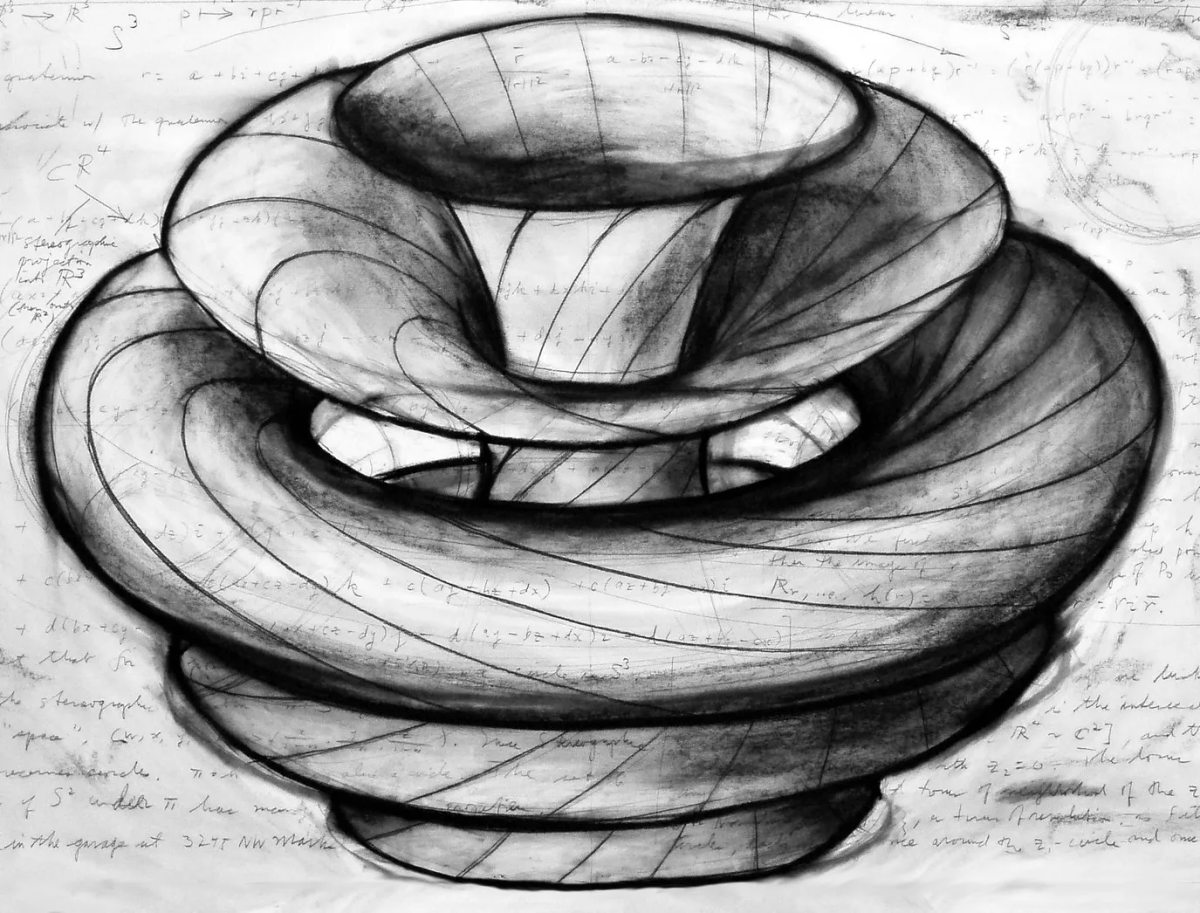
This hub houses materials exploring the fundamental metaphysical commitments embedded within formal logic. Examining the architectural choices of foundational mathematics exposes the philosophical assumptions governing modern theoretical sciences and computational frameworks. The choice of a mathematical foundation is a categorical declaration of ontology—dictating whether we live in a shattered pluralistic hierarchy or a unified monistic totality.
Related Material
-
The Monist Engine
A bare-metal, GPU-accelerated logic engine designed exclusively to compute Quine's New Foundations (NF). By abandoning traditional hierarchical type-checking in favor of geometric shortest-path routing, it safely evaluates unstratified, self-referential paradoxes and cyclic graphs, compiling them into executable Interaction Nets. -
NF-Sketches
A proof-theoretic Lean 4 companion to the recent NF consistency result by Holmes and Wilshaw, providing the syntactic and deductive machinery to operate within a monist universe. It features an algorithmic stratification checker, an interactive REPL sandbox, and a formal diagnostic tool embedding Gentzen's Sequent Calculus to mechanically explore cut-elimination failures under Quine's systemic ambiguity. -
W.V.O. Quine and the Universal Set
Introduces Quine's New Foundations logic as a formalization of Substance Monism. It contrasts this closed, self-containing reality with the fragmented hierarchy of ZFC, exploring the "diabolical" (a term invented by Forster and Holmes) consequences of the Universal Set. -
House of Mirrors
Explores the radical cosmological implications of living in the closed, static Monist universe dictated by NF. It reinterprets cosmic expansion, light, and time dilation as geometric illusions of logical stratification.
Architecture
I. The Epistemic Basis
Quine observes that abandoning the dogmas of empiricism results in "a blurring of the supposed boundary between speculative metaphysics and natural science" (Quine 1951, 1). Adopting a specific formal logic therefore constitutes an inherent cosmological claim. Because ontological questions are on a par with questions of natural science (Quine 1951, 18), deploying New Foundations functions as an active scientific framework for a monistic universe. Formal logic relies heavily on a vast plurality of expressions, variables, and structural descriptions, which might seem to contradict the existence of a single, unified substance. Resolving this tension requires recognizing that linguistic plurality does not necessitate ontological plurality. By maintaining a strict distinction between meaning and naming, it becomes clear that distinct singular terms and complex structural descriptions can name the exact same underlying entity while differing entirely in their conceptual meaning (Quine 1951, 1-2).
We demonstrate this by analyzing NF’s core axioms, its syntactic mechanism for managing self-reference, and the severe cosmological constraints dictated by its internal logic.
II. Axioms & Definitions
To proceed systematically, we establish the foundational axioms and definitions that structure this argument.
- Definition 1: Substance Monism. Following classical definitions, substance monism posits that reality consists of exactly one independent substance. All particular objects or events exist as modes or affections inhering within this singular totality (Kisner in Spinoza 2018, xxi-xxii). Driven by a historical desire for coherence, this architecture insists on a self-caused entity, where the ultimate reality contains its own justification and existence, relying on no external variables or higher-order containers (Spinoza 1677, 3).
- Axiom 1: The Metaphysics of Logic. The choice of mathematical foundation dictates ontology. Logic serves as an active modeling choice, dictating whether we live in a shattered pluralistic hierarchy or a unified monistic totality.
- Definition 2: The Universal Set ($V$). The universe of all sets explicitly contains itself, perfectly mirroring the classical metaphysical definition of a substance conceived entirely through itself (Morris 2018, 68). Formally, $V = {x \mid x = x}$.
By asserting the existence of the Universal Set ($V$), NF perfectly mirrors the classical definition of a self-contained monistic substance. Because the formula $x=x$ is stratified within NF, its extension—the universal set—exists as a valid, quantifiable object within the system (Holmes 2011, 2). NF accommodates "big sets" and aligns with the logicist tradition, treating sets strictly as the logical extensions of properties (predicates-in-extension) rather than bounded physical collections. A universal set perfectly mirrors the predicate of self-identity, encapsulating the philosophical position that consciousness and experience are unitary, rejecting the artificial divisions imposed by cumulative hierarchies (Forster 1995, 11-12). However, this monistic universe is internally dynamic. The stratification mechanics do not merely contain reality; they act as an internal process of self-differentiation, allowing the single substance to articulate itself into complex structures without fracturing its fundamental unity.
This stands in sharp contrast to the pluralistic reality implied by standard Zermelo-Fraenkel set theory with Choice (ZFC), which builds a fragmented and ever-expanding hierarchy of sets. To understand why ZFC fails to provide a monistic framework, we must look to Quine’s strict distinction between virtual and real classes. The virtual theory of classes permits discourse mimicking class assumptions without genuinely invoking classes as values of quantifiable variables (Quine 1963, 20). Because ZFC cannot contain a universal set, its "proper classes" (like the class of all sets) represent a refusal of ontological commitment—a fragmented, virtual treatment of the absolute whole. NF, conversely, commits fully to the reality of $V$, treating the whole of existence as a singular, quantifiable reality, formally securing a single, all-encompassing arena directly within its object language (Maddy 1997, 25-26).
III. Operating Within the Monist Universe
How can a formal system contain a universal set without succumbing to classical paradoxes? Historically, the Vicious Circle Principle emerged to block impredicative definitions, fracturing the logical universe into ramified and simple types to prevent any collection from containing members defined in terms of the whole (Maddy 1997, 8-13).
NF circumvents these paradoxes by moving type restrictions from the ontology to the syntax. Quine employs syntactic stratification rather than fracturing the actual universe into strictly separated ontological types. A formula is considered stratified if it is possible to assign a non-negative integer type to each variable aligning with the well-formed formulas of type theory (Holmes 2011, 2). Stratification serves as a systemic criterion to dictate whether a condition determines a class, functioning as a positive mechanism to manage self-reference without requiring the universe to be ontologically shattered into types (Rosser 1953, 206). Consequently, the objects themselves remain entirely untyped and unified within a Universal Set (Quine 1937, 70-80).
Navigating Paradoxes through Stratification:
To maintain its monistic totality without succumbing to classical paradoxes, NF relies on the syntactic mechanics of stratification:
- Russell's Paradox: The formation of the Russell class is traditionally fatal to systems containing a universal set. NF circumvents this because the defining formula $x \notin x$ is unstratified, meaning the scheme of stratified comprehension does not generate the paradoxical set (Holmes 2011, 2; Forster 1995, 24). Formally, the condition $\exists y \forall x (x \in y \leftrightarrow \phi(x))$ fails to instantiate a set $y$ when $\phi(x)$ is the unstratified formula $x \notin x$.
- Cantor's Paradox: Cantor's paradox of the largest cardinal is cleanly evaded. While Cantor's theorem demonstrates that the power set of a set is strictly larger than the set itself, applying this to the Universal Set requires a diagonal argument that relies on an unstratified condition, rendering the contradictory diagonal set non-existent in NF (Forster 1995, 24). The standard unstratified form of Cantor's theorem fails in NF. The stratified form successfully proves that the set of one-element subsets of the universe is strictly smaller than the power set of the universe (Holmes 2011, 2-3).
- The Burali-Forti Paradox: NF allows the class of all ordinals to exist as a set. This circumvents the paradox by preventing the proof that each ordinal counts the sequence of its predecessors in their natural ordering (Forster 1995, 24).
Structural Consistency and Ambiguity:
Validating the mathematical rigor of the monistic universe, NF is equiconsistent with the theory of types. A one-sorted theory like NF shares the exact same stratified theorems as the many-sorted theory of types augmented with axioms of ambiguity (Boffa 1977, 215). Swiss mathematician Ernst Specker provided the crucial formal proof for this connection by demonstrating the principle of "typical ambiguity." Specker's findings confirm that within these logical structures, shifting all types by a constant integer preserves truth values, allowing the infinitely layered hierarchy of types to collapse into a single, unified domain (Boffa 1977, 215-216). This collapse provides the technical justification for the transition from pluralistic type theory to substance monism.
Unit-Class Reduction:
To achieve a truly unified domain, the system must also reconcile the difference between abstract classes and concrete individuals. This monistic architecture is further refined by the mechanics of self-membership and minimalist primitives. Quine notes that resolving the awkwardness of urelements (individuals that are not sets) by identifying them with their unit classes ensures everything counts as a single ontological type: a class (Quine 1963, 32). Formally, if an individual $x$ is identified with its unit class ${x}$, then $x = {x}$, meaning $x \in x$. If individuals are identical to their unit classes, the boundary between substance (the individual) and structure (the class) dissolves. The Universal Set is not a mere container of disparate atoms; it is a unified fabric constructed from a single ontological primitive. Underscoring the elegance of this architecture, Quine's system possesses a foundational simplicity. All traditional pure mathematics translates contextually into a highly restricted logical vocabulary relying entirely on three operations: membership ($\in$), alternative denial (NAND), and universal quantification ($\forall$) (Quine 1937, 70-72). The variables in this system denote any object whatever, fusing individuals and classes into a single domain of discourse without segregating reality into distinct logical types (Quine 1937, 71).
IV. Cosmological Implications
This total unity exacts a steep ontological price. Admitting the Universal Set ($V$) forces the internal logic of the universe to undergo severe structural contortions, directly impacting notions of counting, identity, and infinity.
- The Failure of Counting and Choice: To sustain the Universal Set, the universe must be diabolical, necessitating the failure of the Axiom of Choice (Specker 1953, 972). Because the Axiom of Choice is mathematically provable for all finite sets, disproving it for the universal context provides the axiom of infinity as a direct corollary, proving that the universe cannot be finite. Consequently, the monistic universe of NF is inherently and demonstrably infinite. It generates its own complexity without requiring external assumptions. Furthermore, standard NF may fail to satisfy the Axiom of Counting ($AxCount \le$), meaning the universe cannot reliably map standard integers to its own singletons. The operational logic of sequence breaks down at the limit.
- The Identity of Indiscernibles: In a universe defined by a tangled web of symmetries, the ability to distinguish objects by their location in a hierarchy collapses. If two objects are structurally symmetric such that no stratified function can distinguish them, their identities merge. This defies the pluralistic assertion that reality consists of a radical plurality of independent entities.
- The Holographic Bound in Logic: In ZFC, Cantor's Theorem guarantees that the power set is strictly larger than the set ($|A| < |\mathcal{P}(A)|$). In NF, this theorem fails for the Universe itself ($|V| \not< |\mathcal{P}(V)|$). The parts cannot outgrow the whole. This results in a reality where the interior complexity is crushed by the system's boundary conditions, leaving a tightly bound, impenetrable monistic sphere.
This mathematical monism serves as the rigorous foundation for the "House of Mirrors" concept, proving that cosmic expansion or logical stratification are internal geometric properties of a single, self-containing structure. In a closed, deterministic universe where the parts cannot outgrow the whole, external temporal or spatial progression is precluded. Dynamic cosmological phenomena, such as cosmic expansion or time dilation, must therefore be reinterpreted as internal geometric illusions or structural stratifications operating within a static, all-encompassing whole.
V. Contextualization
To highlight the radical nature of this monistic universe, it is useful to contextualize it against the pluralistic paradigms dominating contemporary logic and physics. Logical atomism posits that reality breaks down into a collection of independent facts and distinct logical atoms (Pears Intro in Russell 2010, viii-ix). Proponents of this view reject monistic logic outright. They argue that insisting upon a single unified whole destroys the structural relations necessary to make sense of distinct physical and mathematical states (Russell 2010, 144). Nancy Cartwright's critique of fundamentalism further intensifies this contrast. She envisions a "dappled world" characterized by a patchwork of distinct disciplines, erratic overlaps, and localized behaviors, wholly rejecting the pyramidal structure of universal laws (Cartwright 1999, 1-2). Integrating Otto Neurath’s assertion that a unified and closed scientific system constitutes a "great scientific lie" sharply illuminates the intense philosophical resistance a strictly monistic logic faces in contemporary thought (Cartwright 1999, 6). Positioning Quine's New Foundations against this specific pluralist backdrop establishes the stakes of adopting a closed, self-containing reality.
This atomistic philosophy deeply influenced standard hierarchical systems like Russell's own theory of types and Zermelo-Fraenkel (ZF) set theory. These standard systems deliberately fragment reality into endless, ascending levels to avoid paradoxes of self-reference. This effectively outlaws any formal representation of a singular, complete universe. Furthermore, ZFC relies on a model-theoretic semantics that strictly divorces the formal object language from the natural metalanguage. This replicates Cartesian dualism within mathematical logic by requiring an external, transcendent "model" to provide meaning.
Contemporary Alternatives
While standard ZFC remains dominant, modern foundational mathematics reveals parallel shifts away from rigid hierarchies that are worth comparing to NF. Homotopy Type Theory (HoTT), for example, provides a robust alternative to classical set theory because it discards the intricate hierarchical membership structure of ZFC ($\in$) in favor of univalent foundations ($=$) (The Univalent Foundations Program 2013, 6). Through the Univalence Axiom, HoTT internalizes judgments of equivalence directly into the foundational logic. Formally, it asserts that equivalence is equivalent to identity: $(A \simeq B) \simeq (A = B)$. This functions as an active, constructive method, providing a finite routine for transporting proofs and structures between equivalent spaces. Similarly, Category Theory abstracts away from element-based collections entirely to prioritize structural transformations (Awodey 2010, 1-2). Metaphysically, these conceptually articulated type and category structures reconceive mathematical objects. They emerge as entities actively constituted through networks of structural justification and normative equivalence, moving beyond the traditional view of inert, extensional matter.
Limits of Pluralistic Empiricism
The resistance to monistic logic often stems from deeply ingrained empiricist assumptions that view reality as a collection of isolated, observable facts. Recognizing the monistic architecture of NF provides a critical lens for evaluating these dominant pluralistic paradigms. The philosophical weight of this dialectic requires heavily critiquing the foundational assumptions of empiricism itself. Empiricist frameworks traditionally rely on non-inferential, foundational knowledge derived from direct sensory data. However, this reliance has been famously dismantled as the "Myth of the Given" (Sellars 1997, 14-15). Empirical knowledge operates as a rational, self-correcting enterprise devoid of absolute empirical foundations (Sellars 1997, 78-79). Aligning Quine's closed reality with this anti-foundationalist epistemology demonstrates that substance monism transcends the need for atomic givens. Knowledge emerges exclusively through inferential articulation and social practice, bypassing isolated sensory inputs entirely (Rorty intro in Sellars 1997, 4-5). Framing the discussion around this rejection of immediate perception fortifies the assertion that a monist universe provides a supremely coherent cosmological and logical architecture.
VI. Open Questions
Beyond its role in formal syntax, adopting the monistic logic of New Foundations offers a structured framework for re-evaluating canonical philosophical problems. By shifting the meta-ontological baseline from a pluralistic hierarchy to a unified totality, researchers can approach entrenched debates from alternative perspectives.
Overcoming the Parmenidean Sphere
Since Parmenides, strict monism has often been interpreted as a static, unchanging sphere. Under this interpretation, all multiplicity, time, and change are dismissed as mere illusions. This is because separating distinct objects seemingly requires admitting "the void"—a state of non-being that a strict monist universe cannot contain. However, formalizing monism through a system like NF demonstrates how a singular, all-encompassing reality ($V$) can be internally dynamic. The syntactic mechanics of stratification allow the single substance to articulate itself into complex, distinct structures without fracturing its fundamental unity or requiring an ontological void. This provides a rigorous mathematical framework for dynamic monisms (such as those of Spinoza or Hegel), proving that reality can be both absolutely singular and infinitely complex.
Reversing the Direction of Grounding
Standard analytic philosophy, heavily influenced by logical atomism and ZFC, operates on a bottom-up, pluralistic assumption: fundamental reality consists of microscopic parts (atoms, empty sets), and the Whole is merely a derivative aggregate. A monistic logical framework naturally aligns with priority monism (championed by Jonathan Schaffer), which reverses this direction of grounding. If the Universal Set ($V$) is the primary, self-containing reality, then the cosmos as a whole is the single fundamental substance. Individual objects—tables, planets, and people—function as dependent fragments abstracted from the single, interconnected web, rather than independent building blocks. This top-down meta-ontology offers highly effective conceptual tools for interpreting holistic phenomena in quantum mechanics (such as entanglement) where the state of the whole strictly determines the state of the parts.
Resolving the Mind-Body Problem
The Cartesian dualism that inspired so much of modern philosophy struggles to explain how a non-physical mind interacts with a physical body. Conversely, strict physicalist pluralism often resorts to eliminative materialism, denying the reality of subjective experience entirely. A monist stance revitalizes Russellian monism, which posits that the intrinsic nature of fundamental physical entities is phenomenal. By treating reality as a single, neutral substance that possesses both structural/extensional properties (the physical) and intrinsic/intensional properties (the mental), monism bypasses the hard problem of consciousness without invoking supernatural theology or denying lived experience.
Integrating the Manifest and Scientific Images
Wilfrid Sellars famously distinguished between the Manifest Image (the everyday world of human intentions, colors, and moral obligations) and the Scientific Image (the theoretical world of physics and micro-particles). Pluralistic paradigms often force a choice between the two, treating them as incompatible realities. A rigorously defined monistic cosmology, however, demands a stereoscopic vision. It provides the philosophical justification for treating the normative language of human experience and the austere descriptions of physics as distinct structural descriptions referring to the exact same underlying, unified substance, bypassing the need to view them as competing ontologies.
Future Research
This paradigm shift opens several avenues for ongoing inquiry. How does the failure of the Axiom of Choice within a universal set impact our models of human agency and physical determinism? If the universe is a tightly bound, impenetrable monistic sphere (the holographic bound), how do we mathematically formalize the illusion of infinite external expansion? Finally, researchers can computationally map the exact boundaries of Quine's systemic ambiguity to ask a more modern structural question: can the syntactic mechanics of stratification be utilized to build a unified artificial intelligence architecture that processes reality as a singular, cohesive network rather than a fragmented hierarchy of isolated data points?
VII. Conclusion
Symbolic logic is a mathematical model constructed by deliberately selecting essential features of deductive thought (Enderton 2001, xi). Framing logic in this manner validates that formal systems dictate the metaphysical shape of the resulting universe. Formal logic is never philosophically neutral.
Choosing NF over ZFC is a deliberate architectural decision to live in a unified totality rather than a shattered hierarchy. The philosophical justification for adopting NF over standard hierarchical models lies in the distinction between conceptual analysis and explication. The dominant iterative conception of sets relies on conceptual analysis, assuming there is one rigid, intuitively correct notion of reality derived from building collections from the bottom up ($\emptyset \subset {\emptyset} \subset {\emptyset, {\emptyset}} \dots$). Quine, however, approached foundational logic through explication, treating axiomatic systems as pragmatic, exploratory tools designed to clarify specific aspects of our conceptual scheme (Morris 2018, 5). Consequently, NF serves as an explorative mathematical explication of the absolute infinite ($V \in V$).
To rigorously support this explication, utilizing a constructivist metalanguage—as demonstrated in tools like nf-sketches—provides the necessary proof-theoretic framework. By embedding Gentzen's Sequent Calculus, derivations within NF can be tracked step-by-step through cut-elimination and structural rules. As established in structural proof theory, this approach allows proofs to be studied as foundational epistemic objects in their own right, demonstrating how the operational rules of the calculus strictly define the meaning of the logical constants (Negri and von Plato 2001, 5-8).
Furthermore, the application of cut-elimination ensures that these derivations possess the subformula property. This guarantees that the monist system remains internally consistent, and that proofs can be executed analytically without requiring external, transcendent models for semantic justification (Negri and von Plato 2001, 28-33). Ultimately, this treats the logic as a "growing object" of mental construction, providing a guided, analytic method of deduction.
By incorporating the Universal Set ($V$), NF provides the syntactic machinery to construct rigorous models of the absolute infinite. This demonstrates that the fear of paradox does not require shattering the universe into fragmented types. Utilizing this explicative, constructivist methodology empowers the reader to view logic as an active modeling choice. Accepting the logical premises of NF forces heterodox logicians to abandon the comfortable, atomistic metaphysics of the "Iterative Conception," providing the exact deductive machinery required to operate within a rigorously defined monist cosmology.
References
Awodey, Steve. (2010). Category Theory (2nd ed.). Oxford University Press.
Boffa, M. (1977). The Consistency Problem for NF. The Journal of Symbolic Logic, 42(2), 215–220.
Cartwright, Nancy. (1999). The Dappled World: A Study of the Boundaries of Science. Cambridge University Press.
Enderton, Herbert B. (2001). A Mathematical Introduction to Logic (2nd ed.). Academic Press.
Forster, T. E. (1995). Set Theory with a Universal Set: Exploring an Untyped Universe (2nd ed.). Clarendon Press.
Holmes, M. Randall. (2011). The equivalence of NF-style set theories with "tangled" type theories; the construction of w-models of predicative NF (and more).
Maddy, Penelope. (1997). Naturalism in Mathematics. Clarendon Press.
Morris, Sean. (2018). Quine, New Foundations, and the Philosophy of Set Theory. Cambridge University Press.
Negri, Sara, and von Plato, Jan. (2001). Structural Proof Theory. Cambridge University Press.
Quine, W. V. (1937). New Foundations for Mathematical Logic. The American Mathematical Monthly, 44(2), 70–80.
Quine, W. V. (1951). Two Dogmas of Empiricism. The Philosophical Review, 60(1), 20–43.
Quine, W. V. (1963/2009). Set Theory and Its Logic (Revised ed.). Harvard University Press.
Rosser, J. Barkley. (1953). Logic for Mathematicians. McGraw-Hill.
Russell, Bertrand. (2010). The Philosophy of Logical Atomism. Introduction by David Pears. Routledge Classics.
Sellars, Wilfrid. (1997). Empiricism and the Philosophy of Mind. (With an Introduction by Richard Rorty and a Study Guide by Robert Brandom). Harvard University Press.
Specker, Ernst P. (1953). The Axiom of Choice in Quine's New Foundations for Mathematical Logic. Proceedings of the National Academy of Sciences, 39(9), 972–975.
Spinoza, Benedict de. (1677/2018). Ethics: Proved in Geometrical Order. Edited by Matthew J. Kisner. Cambridge University Press.
The Univalent Foundations Program. (2013). Homotopy Type Theory: Univalent Foundations of Mathematics. Institute for Advanced Study.