The Granger Theorem

Preamble
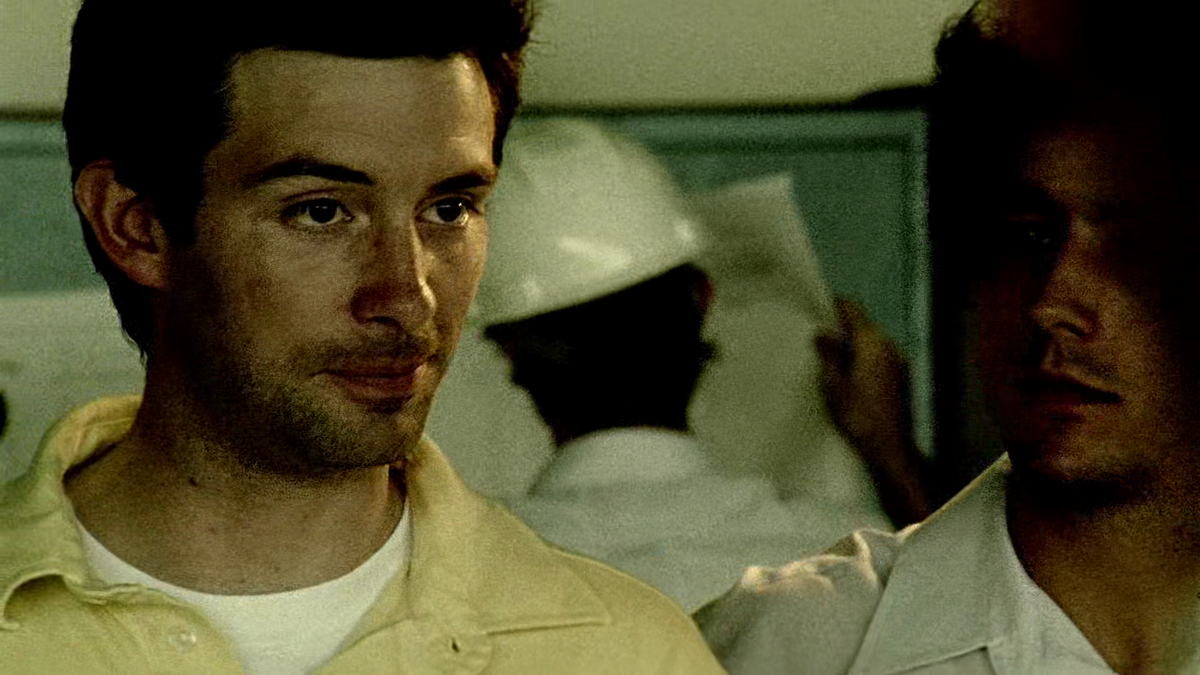
This text is not a review or an explainer. It attempts to construct a formal model of Shane Carruth’s 2004 film Primer, treating the work as an axiomatic system to be reverse-engineered. The film's notorious difficulty constitutes its primary aesthetic and philosophical statement: it models the high-modernist dream of a world built from first principles, perfectly rational and legible. In this sense, the protagonists, Abe and Aaron, are strict adherents to the early philosophy of Ludwig Wittgenstein. They proceed as if the world is a "totality of facts" (Wittgenstein 2021, 5) that can be perfectly captured by a logical language (25). They build their Box to create this language for a segment of reality, believing that if they can establish the correct logical syntax, they can master the facts it describes. They operate as if they can ignore the foundational lesson of quantum theory: that Nature, at her most fundamental level, is "absurd from the point of view of common sense" (Feynman 2006, 10).
To formalize this project, the essay translates the film’s narrative rules into first-order logic (FOL), treating the Box as a Turing machine: an idealized computer designed to execute a set of explicit rules (Boolos, Burgess and Jeffrey 2007, 23). This symbolic language allows us to represent the film's physical laws as unambiguous axioms from which we can derive specific consequences (Magnus et al. 2025, 190–192). Like Wittgenstein’s Tractatus Logico-Philosophicus, this essay derives its claims formally. It establishes the core Definitions and Axioms of the film's universe, then treats its key events as Propositions to be proven within a system of natural deduction (110), a calculus designed by Gerhard Gentzen to "come as close as possible to actual reasoning" (Gentzen 1964, 289). By deriving narrative conclusions from logical assumptions, we mirror the engineers' own attempt to reduce the chaos of time travel to a solvable equation.
Finally, the essay explores how the system fails catastrophically when it collides with messy human reality. This collapse is framed through the lens of the Curry-Howard Isomorphism, or "Propositions as Types," which reveals a deep structural correspondence between the laws of logic and the mechanics of computation (Wadler 2015, 75). The system's failure is therefore both a logical contradiction and a computational one, a type error in a program for reality that results in a runtime crash. The film’s tragedy demonstrates that when such high-modernist projects of pure rationality are loosed upon the world, they inevitably collapse into paradox and ruin (Magnus et al. 2025, 138–139). The ultimate victor is the cynical operator Aaron, who learns to exploit the system's failures—a pessimistic corollary for our own technocratic age.
Part 1: The Formal System of the Box
To understand Primer's narrative, one must understand its physics. The plot unfolds from the logical consequences characters deduce from immutable physical laws. Here, we establish the foundational principles from which all narrative consequences derive, translating them into FOL to build a precise, formal model.
DEFINITION A: The Box
The Box generates a closed temporal field between two points in spacetime: when it is activated (Point A) and when it is deactivated (Point B). It is a self-contained causal loop generator, a state of being rather than a vehicle for travel.
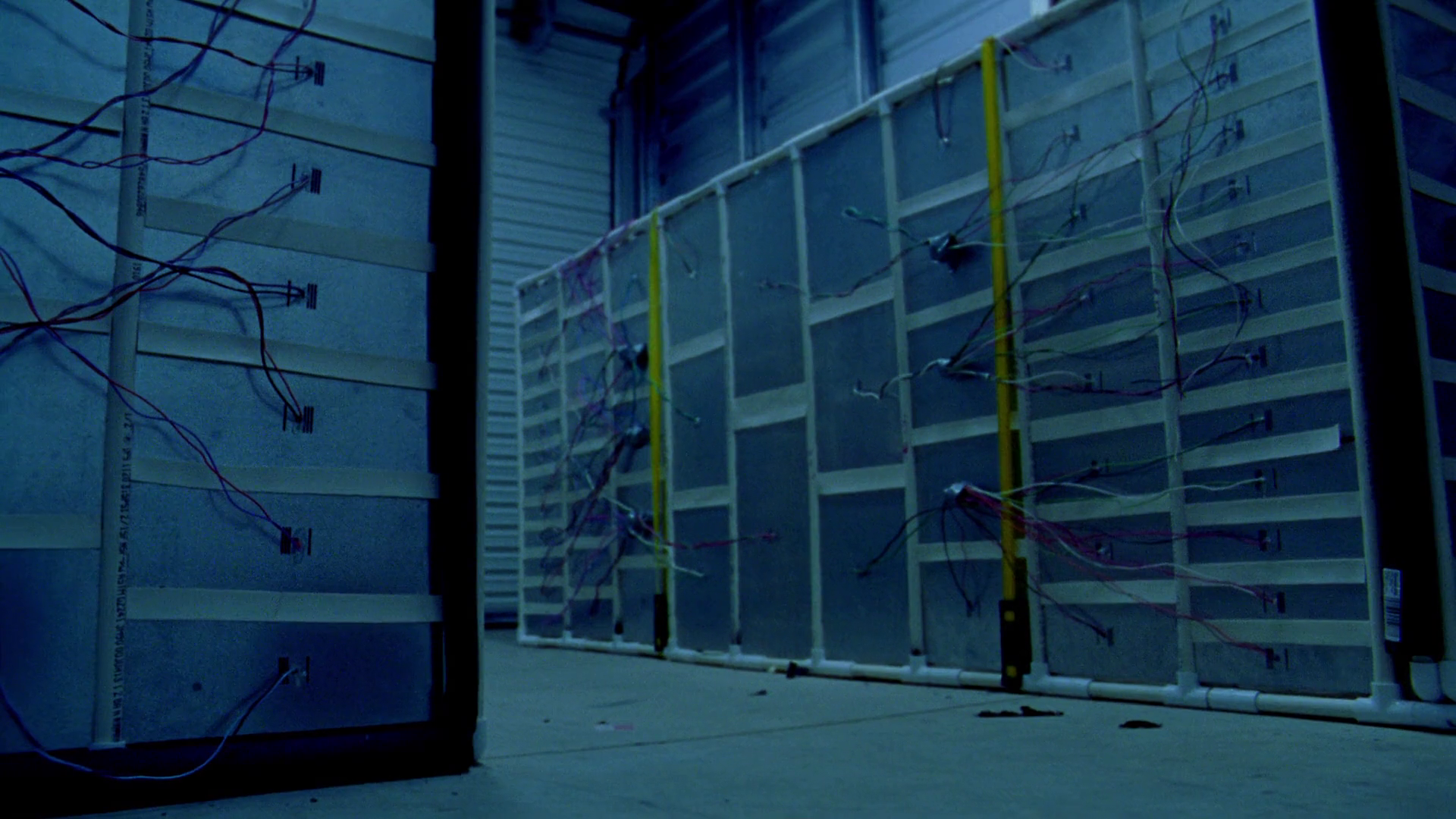
The device originates as a serendipitous byproduct of what Steven Johnson calls tinkering in the "adjacent possible" (Johnson 2010, 29). Abe and Aaron, pragmatic engineers, stumble upon a radical anomaly while repurposing scavenged parts. This origin is crucial: no state-funded laboratory produced this technology. The machine’s physical form reflects its mundane genesis. It is an unglamorous, coffin-sized container, devoid of cinematic spectacle. This radical banality grounds the system in a recognizable reality of budgets and material constraints. It testifies to the power of tinkering, but also warns that the power to reshape reality can emerge from unassuming origins with no built-in safeguards. The Box is a pure mechanism (indifferent to its operators' intentions) that executes its function according to its design.
DEFINITION B: The Field (The Parabolic Loop)
The Field is the state within an active Box. Inside it, time oscillates in a repeating parabolic curve from A to B and back towards A. An object experiences approximately 1,300 temporal traversals for every one in external spacetime.
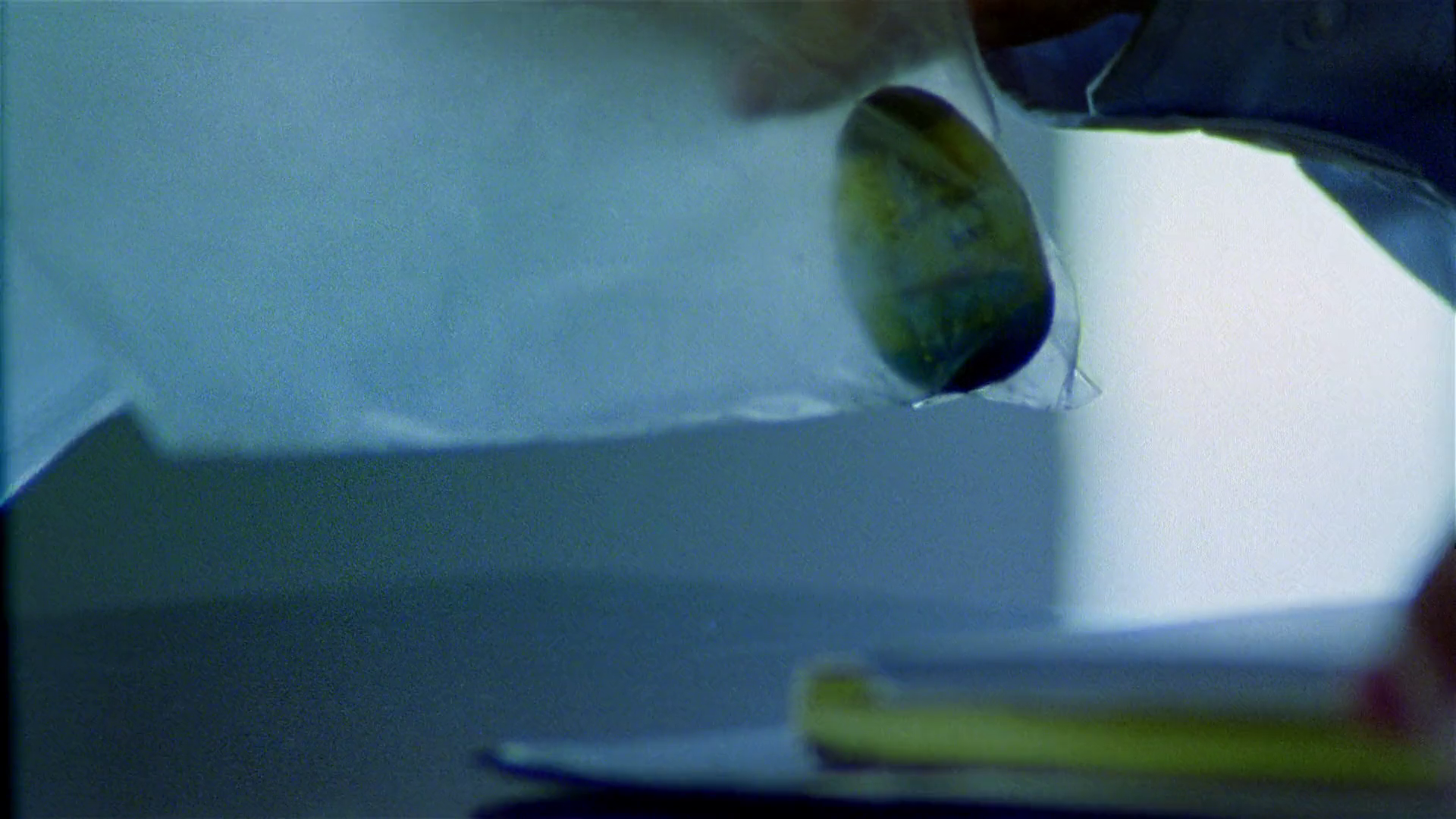
The Box first reveals its anomalous properties when a fungus, Aspergillus Ticor, grows at an accelerated rate on a test object; a protein film that would naturally accumulate over six years appears in days. The Field's structure causes this phenomenon. As Abe explains, an object inside the box travels forward in time from the machine's activation (Point A) to its deactivation (Point B). Upon reaching Point B, however, its temporal path "curves back around towards the A end," repeating this journey until a probabilistic threshold is met.
This mechanic has a direct, if simplified, theoretical basis in Richard Feynman’s work on quantum electrodynamics, which resolves an apparent asymmetry in the behavior of light by modeling a positron as an electron moving backward in time (Feynman 2006, 98). At the subatomic level, whether a particle moves forward or backward in time is a matter of perspective. The Field creates a macroscopic version of this principle. An object inside it exists within a closed loop where temporal directions are no longer distinct. It simply accumulates duration. This distinction is critical: in its primary function, the box serves as a time multiplier.
This concept resonates with modern physics. As physicist Carlo Rovelli explains, our intuitive sense that time flows universally and linearly is a macroscopic illusion. At the fundamental level, "the temporal structure of the world is different from our perception of it" (Rovelli 2018, 59). The world is a complex web of events rather than a sequence of "nows." The Field, therefore, exploits physics' deeper, stranger nature. It places the object in a state where it multiplies duration while the external world proceeds.
DEFINITION C: The Double
The Box creates a duplicate self when a traveler exits it at Point A. The traveler (Self-2) arrives in a timeline already occupied by their prior self (Self-1), who proceeds along the original, unaltered course of action. The Double is a distinct, conscious entity (Magnus et al. 2025, 263).
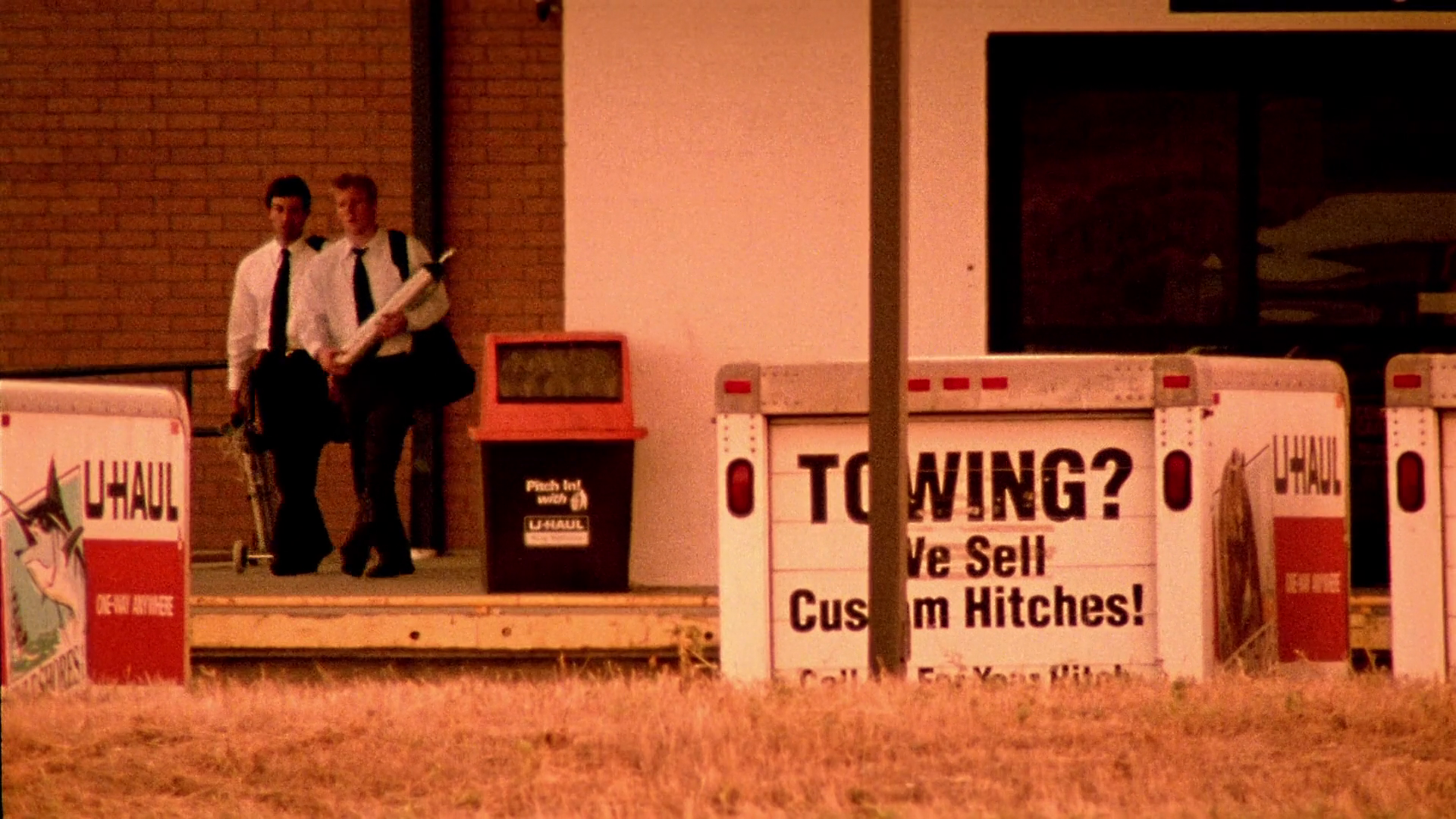
When the engineers transform the box into a time machine, they precipitate its central crisis: creating duplicates. We can formally represent (213) the core implication of time travel with a predicate, $\mathrm{Traveler}(p)$, which is true if person $p$ has used the box. A double's existence is a direct logical consequence: $∀p(\mathrm{Traveler}(p)→∃p′(p′≠p∧\mathrm{IsOriginal}(p′)))$. For any person $p$ who travels in time, there necessarily exists another person $p'$ who is not identical to $p$ and is their original self. This logistical abstraction masks a deep philosophical crisis. The system requires the traveler (Self-2) to treat his prior self (Self-1) as a mere placeholder, a set of actions to be observed and then erased. The initial protocol is designed to "take yourself out of the equation": the traveler sequesters himself in a hotel room, allowing his prior self to complete the loop and enter the box, thereby removing the duplicate. The Double is, in this initial formulation, an error condition to be resolved.
This act literalizes the central thought experiments of philosopher Derek Parfit, who follows David Hume in arguing that our ordinary beliefs about personal identity are mistaken (Parfit 1984, 210). The engineers implicitly hold a Non-Reductionist View, the very conception of a simple, unified self that Hume argued was a philosophical fiction, a metaphysical ghost for which there is no corresponding sensory impression (Hume 1748, Sec. II). They believe their identity to be a "deep further fact, distinct from physical and psychological continuity" (Parfit 1984, 210). This view makes their protocol seem rational: if identity is a simple, indivisible fact, it can be cleanly transferred from one body to another, and the original can be discarded.
The Box, however, is a machine that forces a Reductionist perspective, vindicating Hume. It induces what Parfit calls "fission," a division where one person becomes two (254). Parfit argues that in such cases, identity is not what matters. What matters is Relation R—psychological connectedness and continuity (261). Both Abe-1 and Abe-2 are fully R-related to the Abe who entered the box. The protocol demands that they "delete" Abe-1, an act of profound violence, because it terminates a being who possesses everything that matters for survival, lacking only the technical, one-to-one relation of identity. The traveler, Abe-2, must dis-identify with his past self, viewing him as an object—a him rather than an I. This schism is the system's first and most significant "leak." The engineering mindset fails because it applies a logistical solution to an existential problem. It treats the self as a static thing to be managed, ignoring the reality that a person is a complex process, a "knot of knots in a network of social relations, in a network of chemical processes, in a network of emotions" (Rovelli 2018, 100).
AXIOM I: The Law of Inversion
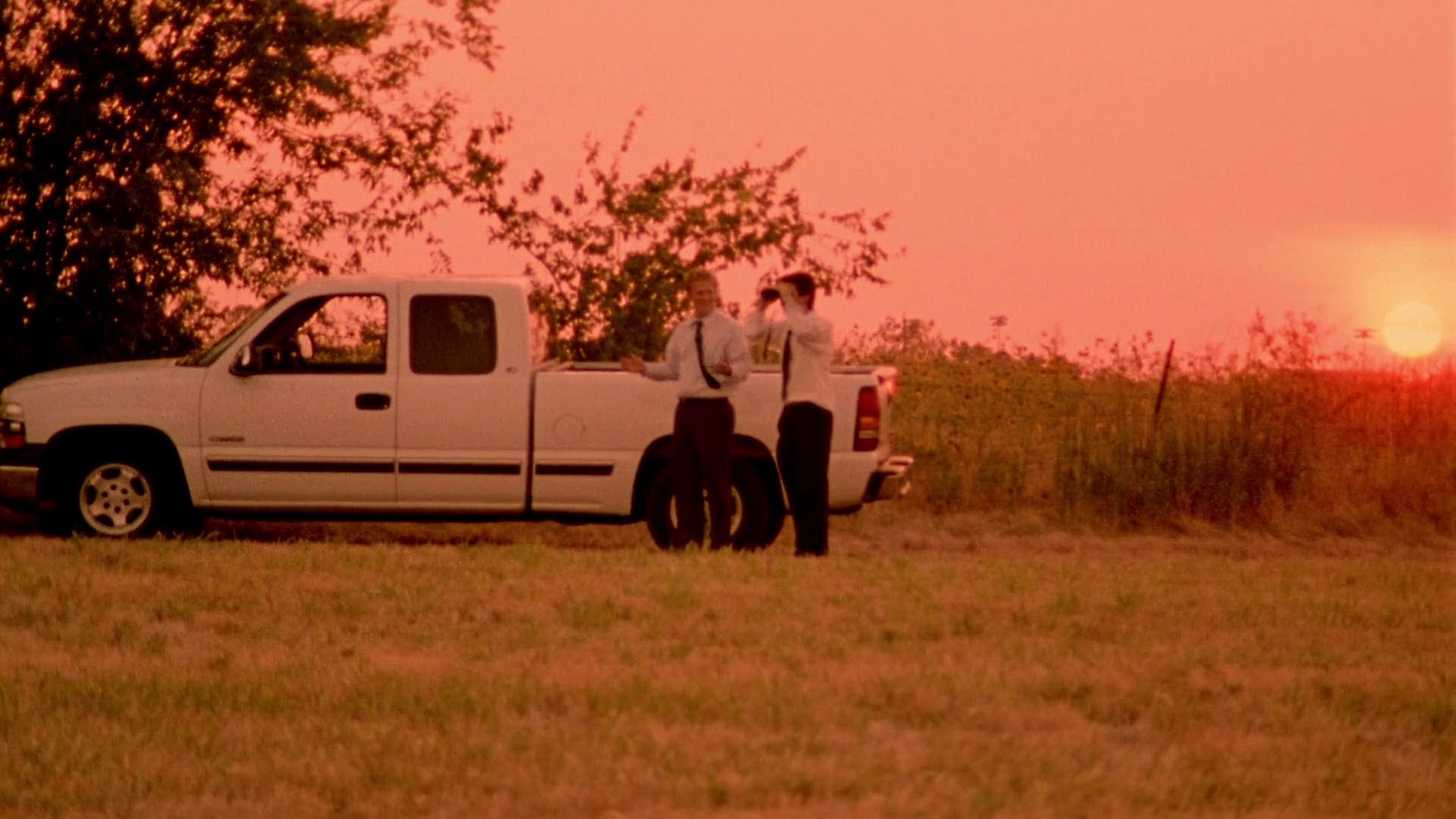
To travel backward, a traveler must enter the active Box at Point B and remain inside for a duration equal to the desired journey. A six-hour journey into the past requires a six-hour experience of reversed temporality within the Field. There are no shortcuts.
This axiom establishes the "thermodynamic cost" of temporal displacement. As Carruth insisted, "you've got to spend six hours in the box" to travel back six hours. This reframes time travel not as a magical leap but as a laborious process grounded in systems thinking (Meadows 2009, 17–21). The Box treats time as a stock. To create a flow of six hours from the past into the present, the traveler must deplete an equivalent stock of six hours from his subjective, conscious experience. Using the predicates $\mathrm{Travels}(p, d)$ for "person $p$ travels back a duration $d$" and $\mathrm{Experiences}(p, d_{\mathrm{in}})$ for "person $p$ experiences duration $d_{\mathrm{in}}$ inside the box," the axiom can be formulated as a universally quantified conditional: $∀p∀d(\mathrm{Travels}(p,d)→\mathrm{Experiences}(p,d))$. The system is a closed loop. To gain six hours of new time, the traveler must sacrifice six hours of subjective experience inside the box. The cost manifests as the physical exhaustion of living "36-hour days."
AXIOM II: The A-Point Constraint
A traveler can journey only as far back as Point A, the moment the Box was first activated. Travel to a time before the machine's activation is impossible. The axiom defines the absolute boundary of the system's operation.
This constraint ensures the system is logically coherent. It prevents self-negating paradoxes (e.g., the "grandfather paradox") because any journey becomes part of the traveler's own history (Lewis 1976, 150). In FOL, if we let $\mathrm{Activates}(b, t_A)$ be true when box $b$ is activated at time $t_A$, and $\mathrm{Arrives}(p, b, t_{\mathrm{arr}})$ be true when person $p$ arrives at time $t_{\mathrm{arr}}$ using box $b$, the axiom is:
$$
\begin{split}
\forall p \forall b \forall t_A \forall t_{\mathrm{arr}} \big( & (\mathrm{Activates}(b,t_A) \land \mathrm{Arrives}(p,b,t_{\mathrm{arr}})) \\
& \to t_{\mathrm{arr}} \ge t_A \big)
\end{split}
$$
The protagonists, however, devise a strategic workaround: they leave their machines running continuously. This action transforms the system's nature. They do not break the axiom, but merely drag its boundary condition further into the past. When they decide to do this, they shift ethically from conducting discrete experiments to building a permanent infrastructure for manipulating time, a choice that dramatically raises the stakes.
AXIOM III: The Principle of Singular Causality
There is only one timeline. A temporal loop does not create a branching parallel universe, but overwrites the previous one. Events from a prior loop exist only in the traveler's memory.
This axiom is the system's most philosophically bleak. While many fictions opt for branching timelines, Primer adopts a brutalist interpretation of David Lewis’s argument for a single, self-consistent history. A time traveler cannot change the past, as their actions are already an integrated part of the one history that exists (Lewis 1976, 146). The film’s system enforces this singularity by violently overwriting the timeline. Formally, this means that for any action $a$, there is a unique outcome $o$:
$$
∀a∀o_1∀o_2((\mathrm{Outcome}(a,o_1)∧\mathrm{Outcome}(a,o_2))→o_1=o_2)
$$
A traveler can introduce new events, but only by annihilating the preceding timeline. The mechanism becomes an act of zero-sum conquest, not participation. The axiom establishes the stakes of the conflict to come: the ultimate prize is not to explore other worlds, but to have the absolute power to dictate the singular history of the only world that is.
Part 2: Logical Consequences of the System
With the system's foundational axioms established, we can derive its narrative consequences. We model the film's major events as formal derivations in a Gentzen-style system of natural deduction, drawing conclusions from premises (the axioms) according to rules of inference (Gentzen 1964, 289). The system's first application is a flawless exercise in rational optimization, while its mature application produces a paradox so intractable it breaks the operator. These propositions demonstrate that the system can produce both perfect logical gain and catastrophic, self-referential failure.
PROPOSITION I: The Game of Perfect Information
Statement: A rational actor can use the system to transform a game of imperfect information into one of perfect information, guaranteeing maximum utility.
Derivation: The stock market exploit, the Box's first practical application, unfolds as a precise procedure:
- A Box is activated at 8 AM, before the market opens (Point A).
- The operators live through the trading day, observing the market's fluctuations and recording the optimal outcome.
- After the market closes, they enter the Box (Point B), initiating a journey back to Point A.
- Upon emerging, they possess complete and perfect information about the game that is about to be played.
- From this position of informational supremacy, they execute a single, perfectly timed trade.

This sequence of events can be formalized as a deductive proof:
- Premise 1: Axioms I, II, and III are true.
- Premise 2: $\mathrm{ObservedOptimalTrade}(T)$ at time $t_{\mathrm{close}}$. (A fact is observed after the market closes).
- Inference (from Premise 1): The possibility of time travel is established. $\mathrm{CanTravel}(t_{\mathrm{close}}, t_{\mathrm{open}})$.
- Action: Enter the box at $t_{\mathrm{close}}$ and exit at $t_{\mathrm{open}}$.
- State at $t_{\mathrm{open}}$: $\mathrm{MemoryOfOptimalTrade}(T)$. The knowledge is retained.
- Inference (Modus Ponens): From the knowledge of the optimal trade and the opportunity to act, the conclusion $\mathrm{ExecuteTrade}(T)$ is derived.
- Conclusion: $\mathrm{GuaranteedProfit}$.
Analysis: This derivation demonstrates the validity of the exploit within our natural deduction framework. The conclusion, $\mathrm{GuaranteedProfit}$, derives rigorously from the axioms and what the operators observe; it imposes perfect, rational order on a chaotic, uncertain system. For a brief period, Abe and Aaron achieve economic prescience. They recall a memory of a timeline that, under Axiom III, no longer exists for anyone but them. Their exploit literalizes the foundational concepts of game theory that John von Neumann and Oskar Morgenstern describe, which models economic behavior as a series of strategic games where rational agents act to maximize their "utility" (von Neumann and Morgenstern 1944, 9). Abe and Aaron's exploit perfectly expresses this principle. They engineer a situation where they know all variables in advance, converting a complex game into a simple optimization problem. Their prescience allows them to bypass risk entirely by acting on the certainty of a past that, for them, has already happened.
The exploit represents the system's seductive phase. It works flawlessly, generates profit with zero risk, and serves as a microcosm for the promise of "Big Data" and algorithmic trading: the belief that one can master any system with enough information. This initial success justifies the escalating risks to come. It proves that the system works, creating a powerful incentive to ignore the grave ontological and ethical dangers it begins to unleash. The clean profit of the stock market exploit is the seed capital for the chaos that follows.
PROPOSITION II: The Breakdown of Protocol
Statement: Any cooperative protocol based on mutual trust is inherently unstable and will collapse into a non-cooperative, zero-sum conflict when two operators can unilaterally alter the timeline.
Proof: We can model the protocol's collapse as a state transition that invalidates the premise of cooperation.
- Initial State: A cooperative game exists, defined by the predicate $\mathrm{Trusts}(\mathrm{Abe}, \mathrm{Aaron}) \land \mathrm{Trusts}(\mathrm{Aaron}, \mathrm{Abe})$. The operators share information and adhere to a mutually agreed-upon protocol.
- Action: Aaron unilaterally uses a failsafe box to alter the timeline, a strategic action that violates the unstated premise of transparency. This is formalized as $\mathrm{Violates}(\mathrm{Aaron}, \mathrm{Protocol})$.
- Inference: When Abe discovers this secret action, he falsifies the initial condition: $\mathrm{Violates}(\mathrm{Aaron}, \mathrm{Protocol}) \to \neg\mathrm{Trusts}(\mathrm{Abe}, \mathrm{Aaron})$. Trust is broken.
- Conclusion: The system degrades into a non-cooperative, zero-sum conflict, where $\neg\mathrm{Trusts}(\mathrm{Abe}, \mathrm{Aaron}) \land \neg\mathrm{Trusts}(\mathrm{Aaron}, \mathrm{Abe})$. The cooperative basis is destroyed.
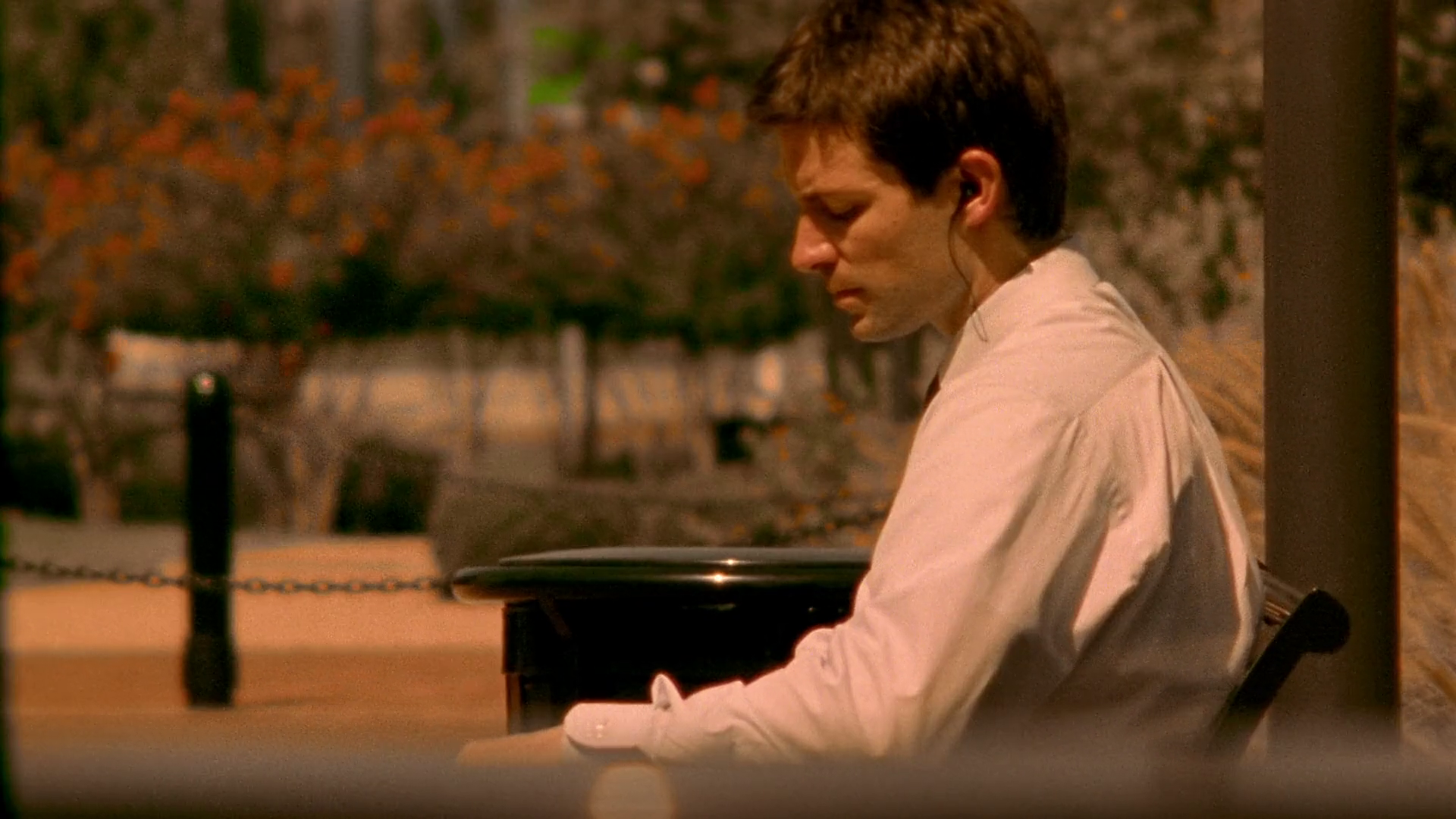
Analysis: The protocol begins to break down with Abe's initial secrecy in building the first Box, but escalates dramatically when Aaron uses a failsafe to become a "Hero" at a party, drugging and imprisoning his prior self to prevent interference. However, a crucial distinction must be made between the operator who executes this strategy (Aaron 2) and the one who performs the heroics (Aaron 3). Far from being the system's master, the Hero at the party acts as its victim: a weakened copy executing a script written by his superior self, Aaron 2, who has already departed to build the warehouse. The Hero is merely a subroutine in a program designed to clean up the timeline. Drugging and imprisoning a Double is the logical endpoint of the philosophical schism described in DEFINITION C. The Double ceases to be a former self and becomes a strategic adversary to be neutralized. The system, designed for rational control, becomes an engine for paranoia.
PROPOSITION III: The Epistemological Crisis and Causal Refoundation
Statement: The system's outputs create an irresolvable ambiguity about its causal structure, an ambiguity resolved only by a theoretical advance that reframes the nature of actuality itself.
The Two Models: Revision vs. Branching
Derivation: The system is founded on the Principle of Singular Causality (Axiom III): the timeline is overwritten. This is the "official" theory. The film's events, however, particularly how the characters interact around the failsafe box and how at least three versions of Aaron co-exist, produce contradictory evidence. This evidence strongly suggests timelines are not overwritten but instead branch into new realities. This contradiction induces an epistemological crisis. The operators face two irreconcilable models of their reality:
-
The Revision Model: A single, editable timeline. This model is clean, orderly, and assumes a final, authoritative "draft" of history. It aligns with the Modernist faith in a singular, knowable truth.
-
The Branching Model: Each significant alteration creates a new, parallel timeline, leaving the old one to continue on its own path. This model, famously imagined by Jorge Luis Borges in "The Garden of Forking Paths," posits a Postmodern reality that is a "growing, dizzying web of divergent, convergent and parallel times" (Borges 1941, 9).
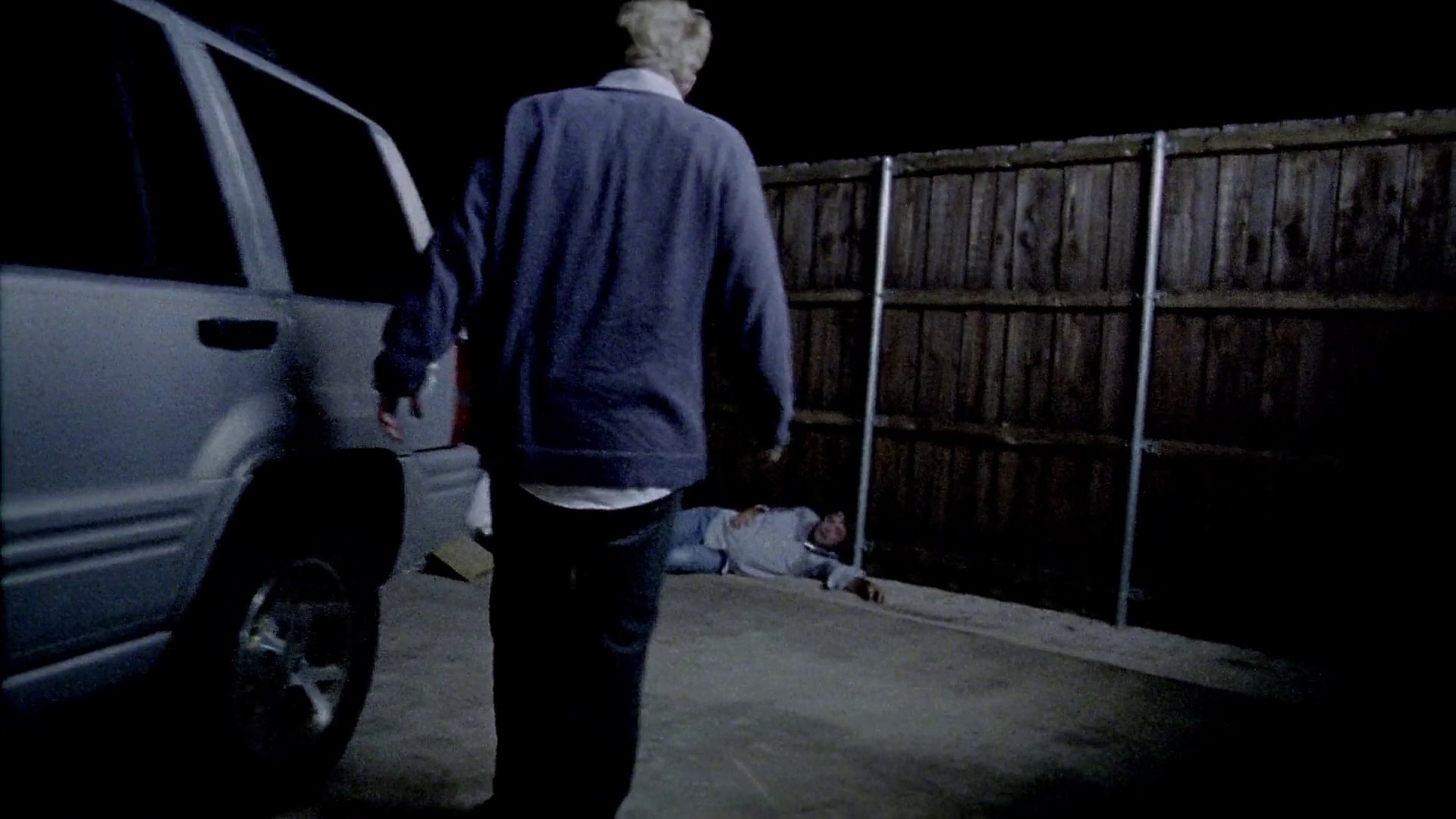
The true horror of Primer is that it forces its characters to operate without knowing which model is correct. If the Revision Model holds, their actions are consequential but ultimately cleanable. If the Branching Model is true, every loop is an act of cosmic irresponsibility that creates abandoned timelines populated by orphaned Doubles. They meddle with forces whose fundamental nature they cannot comprehend. This uncertainty is the system's ultimate failure. A system designed to produce certainty instead generates absolute, paralyzing doubt. Their claim to be prescient is revealed as the ultimate hubris. They are not masters of the system but its first victims, trapped in a labyrinth of their own making, unable to distinguish the true path from the infinite forks of possibility (Wittgenstein 2021, 5).
Theoretical Advance
This epistemological impasse forces a theoretical advance. It rejects the false dichotomy between a multiverse and a single, static history by positing a more fundamental mechanism: Dynamic Actualism. This theory begins by accepting two premises: first, there is only one, actual, four-dimensional block universe (Rovelli 2018, 59). Second, the substrate of this universe is quantum-mechanical, meaning its state is described by a sum over all possible histories (Feynman 2006, 98). The philosophical error is to imagine these "possible histories" as other, concrete worlds. Dynamic Actualism posits that they are not alternative realities but unactualized potentialities immanent within the single, actual world. Before an event is observed or becomes part of the fixed past, it exists as a wave of potential; after, it collapses into a single, definite, classical state. The past is "fixed" only because it is a chain of these definite, collapsed states.
The Principle of Causal Refoundation
From this, a new principle for how the Box functions emerges. It functions as a Causal Refoundation Device, locally un-actualizing a segment of spacetime. It creates a field that suspends the "fixity" of a past region, causing that region to temporarily revert from a definite, classical state back into its underlying quantum state of pure potentiality—the full Feynman sum-over-histories for that local area. It returns the past to its indeterminate, informational substrate rather than erasing it. The machine then provides a new set of boundary conditions at the end of the loop, forcing this bubble of potentiality to re-collapse into a new, definite, classical history. The overwriting of the timeline is the physical process of re-founding a segment of actuality itself.
The Constructive Proof
How the Box operates thus becomes a form of constructive proof. It is a proof that constructs a new history from first principles. Let the single, actual block universe be the manifold $\mathcal{A}$. Let a segment of spacetime history be a region $R \subset \mathcal{A}$, defined by the interval $[t_A, t_B]$. The Box applies a refoundation operator, $\hat{P}$, which maps the definite, actualized history of the region $R$ back to its immanent potential state, the sum over all its possible local histories, $\Psi_R$.
$$
\hat{P} : R \rightarrow \Psi_R = \sum_{\text{paths}} e^{iS/\hbar}
$$
Here, $i$ is the imaginary unit of phase, $S$ is the Action of the path and $\hbar$ is the quantum scale.
At the end of the loop, the machine and its occupants provide a new boundary condition, $C'$, which forces $\Psi_R$ to re-actualize. The proof demonstrates that there exists a new definite history, $R'$, that can collapse from $\Psi_R$ under condition $C'$, such that its boundary with the rest of the unchanged universe ($\mathcal{A} \setminus R$) is perfectly smooth and causally consistent. When the Box operates successfully, it constructively proves that the fabric of actuality can be locally unmade and remade into a new, self-consistent pattern.
The Granger Paradox as a Failed Proof
The Granger Paradox can now be understood as a failed constructive proof. The system attempts to re-actualize a history that is causally inconsistent. The proof proceeds by reductio ad absurdum. Let $E$ be the "future event" that causes Granger to travel.
- Premise 1: $E$ (Assume the future event occurs).
- Premise 2: $E→\mathrm{Travels}(\mathrm{Granger})$ (The event causes Granger to travel).
- Premise 3: $\mathrm{Travels}(\mathrm{Granger})→¬E$ (Granger's arrival prevents the event).
- Inference (from 1, 2): $\mathrm{Travels}(\mathrm{Granger})$ (Modus Ponens, an elimination rule) (Gentzen 1964, 289).
- Inference (from 4, 3): $¬E$ (Modus Ponens).
- Contradiction (from 1, 5): $E∧¬E$.
Deriving a contradiction ($E∧¬E$) demonstrates that no self-consistent history $R'$ can be constructed from the potential state $\Psi_R$ under the new boundary conditions. The system cannot resolve this contradiction logically. Instead, the paradox manifests physically in the operator: Granger falls into a comatose state. His body becomes the site of the failed proof, the physical remainder of a program that could not compile. Granger's state is the system’s fatal error message, the physical manifestation of an uncomputable problem. It is the Halting Problem made flesh: the system, presented with a self-referential paradox, cannot determine whether it will ever reach a stable state, and so enters an endless, catastrophic loop from which it cannot exit (Boolos, Burgess and Jeffrey 2007, 63). This proves that actuality is not infinitely malleable. It is a direct assault on what David Hume called the "cement of the universe" (Hume 1748, Sec. IV), the causal bedrock of conscious experience. The paradox is therefore pathogenic—a condition that attacks the possibility of coherent experience, bringing the entire project to a catastrophic halt.
This new framework offers a path between a rigidly determined block universe and a branching multiverse. It suggests that actuality is a state, not a substance, and that the past is fixed only by a kind of metaphysical inertia that the Box can locally overcome. The past is a pattern of information that can be forced to forget and be rewritten from the quantum potential that underlies it.
This provides a deeper meaning for the Aaron Supremacy. Aaron's mastery becomes something far more absolute. He acts as a sculptor of actuality. He intuits that the universe is not a finished object but a dynamic process of actualization from a sea of immanent potential. He learns how to force the universe to re-deal the cards from the deck of pure possibility. His victory is a testament to a terrifying new principle: that the actual itself is not immutable.
Part 3: Scholia to the Text
SCHOLIUM I: The Failure of the Technocratic Ideal
The Box's formal system does not fail on its own terms. Its axioms are inviolable. The system fails contextually: the closed, logical apparatus collides with the open, irrational, and infinitely more complex system of its human operators.
Abe and Aaron exemplify what James C. Scott calls "high-modernist ideology": a technocratic faith that a simple, rational grid can map and control a complex reality (Scott 1998, 4). As engineers, they treat reality as a problem to be solved, a system to be optimized. Their project fails because their model of human nature is incomplete. They fail to grasp that the world is fundamentally a network of events rather than things, and is better understood "in its becoming, not in its being" (Rovelli 2018, 103). They mistake the ability to calculate for the power to control, forgetting that even a complete physical theory may offer no intuitive explanation for why Nature behaves in her peculiar way (Feynman 2006, 10).
Abe, the system's architect, acts as a proof theorist. He treats the Box's axioms as a type system for reality, operationalizing "Propositions as Types" by treating every logical proof as a program guaranteed to compute a correct result (Wadler 2015, 78). As Philip Wadler explains, this isomorphism means the introductions of logical rules (the axioms) act as definitions, and the eliminations (the consequences) are the logical results of those definitions. Abe attempts to write a "well-typed program" for reality, believing that if his axioms are sound, any "proof" derived from them should execute flawlessly and produce a predictable "value."
The operators' superlative technical skill is paired with a catastrophic incompetence as ethicists and strategists. This cognitive imbalance is not merely a psychological quirk described by the Dunning-Kruger effect (Kruger and Dunning 1999, 1122), but a profound epistemological error. Because they succeed in building the Box, they inflate their sense of mastery, which blinds them to their ignorance. They commit a classic Humean error: they mistake the constant conjunction of events—flipping a switch and observing the result—for a rational insight into the necessary connection that governs causality (Hume 1748, Sec. VII). They believe they understand the machine's "secret springs and principles" because it behaves predictably.
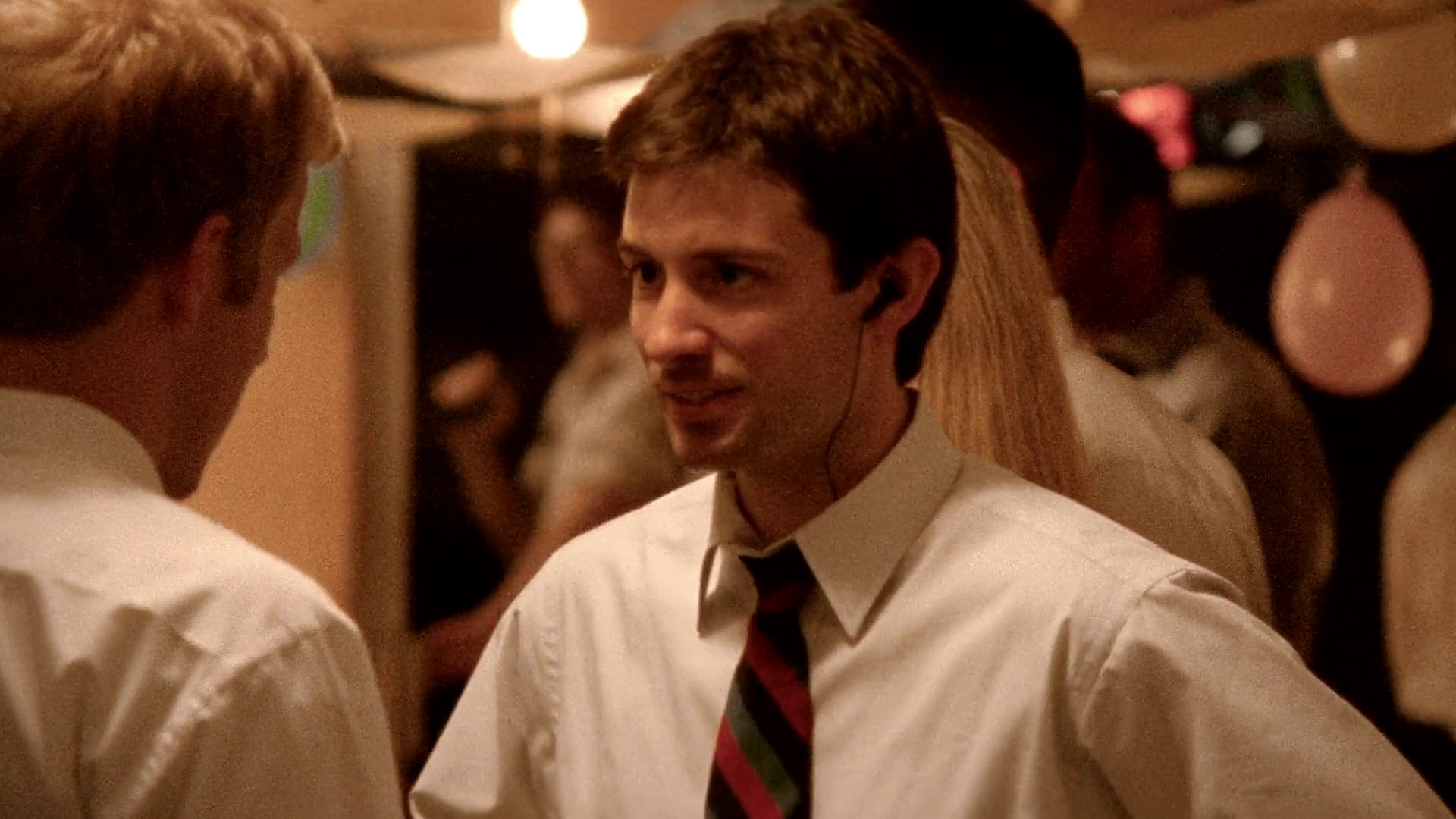
Hume's critique, however, reveals that this sense of understanding is an illusion, a feeling projected by the mind onto the world after repeated experience. The operators' confidence is built not on reason, but on custom. As Kruger and Dunning note, the skills needed to perform a task are "virtually identical to the skills needed to evaluate" one's performance. The operators cannot recognize their folly because they lack the philosophical framework to distinguish between operational success and genuine comprehension.
The Granger Paradox is a fatal type error, a proof that fails to inhabit its specified type. When this program executes—when Granger uses the machine—the type error causes a runtime crash that manifests as his comatose state. The system, designed to produce logical certainty, instead produces a lethal, uncomputable state. This failure can be specified more precisely using the central theorem of Gentzen's work: the Hauptsatz, or main theorem. The Hauptsatz proves that any formal proof can be converted into a "normal form" that is not "roundabout"—a proof where "no concepts enter... other than those contained in its final result" (Gentzen 1964, 289). Such a "cut-free" proof has the subformula property: every step is a constituent part of the final conclusion (298).
The operators' project is an attempt to construct a cut-free proof for reality. Their escalating paranoia, secrecy, and violence, however, are the logical equivalent of "cuts"—messy, roundabout steps and concepts that are not subformulas of their desired outcome. The Granger Paradox is the catastrophic result of a proof that has become so pathologically roundabout that it can no longer be completed. In the language of "Propositions as Types," simplifying a proof corresponds to evaluating a program (Wadler 2015, 75). A proof with "cuts" is a buggy program. The operators' increasingly convoluted interventions are attempts to patch a buggy program that inevitably lead to a fatal runtime crash. This reveals the high-modernist project's fatal flaw: a proof's formal elegance provides no guarantee that it will not catastrophically fail when physically executed.
The operators' technocratic mindset exemplifies what Martin Heidegger calls "Enframing" (Gestell): a way of revealing the world that reduces all being to a "standing-reserve" (Bestand)—a quantifiable resource to be optimized and exploited (Heidegger 1977, 17). The Box is the ultimate instrument of Enframing. It transforms time, causality, and consciousness into a reserve to be manipulated. The Doubles, imprisoned and neutralized, become the most literal form of this reserve; their consciousness is reduced to an obstacle, a variable to be eliminated from the equation.
This mindset is reinforced by their implicit, Non-Reductionist belief in the self. As Parfit argues, this view can make one feel "imprisoned in myself," as if life were a "glass tunnel" through which one moves, separate from all others (Parfit 1984, 281). The operators are trapped in this tunnel. Their inability to see their Doubles as beings with an equal claim to existence is the direct consequence of a metaphysical error: they believe the boundary between selves is absolute because they believe the self is an absolute, further fact. Their project fails because their model of the self is a prison.
This reductionist logic guarantees that the operators' friendship will dissolve. Their partnership begins as one of virtue, in Aristotelian terms: a shared love for the intellectual pursuit of discovery. The Box, however, introduces a resource of infinite utility—control over time—that transforms their relationship into one of utility, which Aristotle argues is the most fragile type, lasting only "so long as they are useful to one another" (Aristotle 1999, 129). As their interests diverge, the relationship becomes a zero-sum competition that a friendship of utility cannot survive. The system does not corrupt them. Its cold neutrality acts as a perfect diagnostic tool, providing a powerful enough incentive to reveal the pre-existing fragility of their ethical commitments.
SCHOLIUM II: The Aaron Supremacy
Primer's formal system has an end-state, a logical conclusion derived from its axioms and the human variable. It is a state of total conflict resolved only when a single, dominant operator emerges. This resolution highlights the crucial distinction between a formal system (logic) and its physical embodiment (computation) (Boolos, Burgess, and Jeffrey 2007, 23-25).
Abe, the architect, is the tragic modernist. He maintains his faith in the ideal of a perfectly rational system and operates entirely within proof theory. Confronted with catastrophic failure, he seeks a better blueprint. His final act is an attempt to travel back and prevent the initial experiment—to debug the proof by erasing it. He is the reformer who believes he can purify the system by perfecting its design. His tragedy is a failure of perspective; he cannot accept that the subjective "flow of time" he experiences is not a fundamental feature of the universe but an emergent property "due to the particular perspective that we have from our corner of it" (Rovelli 2018, 150).
Aaron, the operator, learns a more profound and cynical lesson. He abandons perfecting the formal system to master its physical implementation. He is not a proof theorist but a hacker. He understands that in any complex system, power belongs to the one who exploits the gap between abstract logic and concrete execution. He weaponizes the failsafe, turning Abe’s tool of caution into his primary instrument of dominance. He treats the overwriting timeline as a computational feature to leverage—a mechanism for ensuring he is the final author of reality.
The pessimistic corollary is clear. Our world is governed by the Aarons who find the exploits. The logical end-state of any rationalist project, when introduced into the irrational domain of human ambition, is the Aaron Supremacy. The system did not fail Aaron. It worked perfectly. It selected for the operator most willing to exploit the gap between proof and program, and it rewarded him with absolute control.
References
Aristotle. Nicomachean Ethics. Translated by W. D. Ross. Kitchener, ON: Batoche Books, 1999.
Boolos, George S., John P. Burgess, and Richard C. Jeffrey. Computability and Logic, 5th ed. Cambridge: Cambridge University Press, 2007.
Borges, Jorge Luis. "The Garden of Forking Paths." In Ficciones. 1941.
Feynman, Richard P. QED: The Strange Theory of Light and Matter, expanded ed. Princeton: Princeton University Press, 2006.
Gentzen, Gerhard. "Investigations into Logical Deduction." American Philosophical Quarterly 1, no. 4 (1964): 288–306.
Heidegger, Martin. "The Question Concerning Technology." In The Question Concerning Technology and Other Essays, translated by William Lovitt. New York: Garland Publishing, 1977.
Hume, David. An Enquiry Concerning Human Understanding. 1748.
Johnson, Steven. Where Good Ideas Come From: The Natural History of Innovation. New York: Riverhead Books, 2010.
Kruger, Justin, and David Dunning. "Unskilled and Unaware of It: How Difficulties in Recognizing One's Own Incompetence Lead to Inflated Self-Assessments." Journal of Personality and Social Psychology 77, no. 6 (1999): 1121–1134.
Lewis, David. "The Paradoxes of Time Travel." American Philosophical Quarterly 13, no. 2 (1976): 145–152.
Magnus, P.D., Tim Button, Robert Trueman, and Richard Zach. forall x: Calgary Remix. Fall 2025.
Meadows, Donella H. Thinking in Systems: A Primer. White River Junction, VT: Chelsea Green Publishing, 2009.
Neumann, John von, and Oskar Morgenstern. Theory of Games and Economic Behavior. Princeton: Princeton University Press, 1944.
Parfit, Derek. Reasons and Persons. Oxford: Clarendon Press, 1984.
Rovelli, Carlo. The Order of Time. New York: Riverhead Books, 2018.
Schelling, Thomas C. The Strategy of Conflict. Cambridge, MA: Harvard University Press, 1960.
Scott, James C. Seeing Like a State: How Certain Schemes to Improve the Human Condition Have Failed. New Haven, CT: Yale University Press, 1998.
Wadler, Philip. "Propositions as Types." Communications of the ACM 58, no. 12 (2015): 75–84.
Wittgenstein, Ludwig. Tractatus Logico-Philosophicus. Centenary Edition. Translated by D. F. Pears and B. F. McGuinness. London: Routledge, 2021.